On Friday morning, Allan Kulikoff (University of Georgia) was offering a provocative proposal to solve the crisis in the history profession that included wholesale changes in the way graduate school programs are structured. (Listen to audio from the session):
And two rooms
 down the hall, sociologist Ricardo Duchesne (University of New Brunswick) suggested that "restlessness" was at the heart of Western uniqueness. Duchesne's presentation couldn't have been more different from Peter Coclanis's (UNC-Chapel Hill) plenary address the night before (which should appear soon on C-Span). And it is perhaps indicative of the culture of open conversation that the Historical Society works hard to foster that Coclanis, a past Society president, engaged Duchesne rather than dismiss him.
In the afternoon, there was a terrific session on the "Comparative Ways of War," featuring Brian McAllister Linn (Texas A&M and current president of the Society for Military History), Robert Citino (University of North Texas), and Peter Lorge (Vanderbilt). They combined formidable expertise in (respectively) American, German, and Chinese military history with healthy doses of caffeine-enhanced humor.
In the evening's Christopher Lasch Lecture, “How History Looks Different Over Time: The Case of the First World War," Adam Hochschild traced the development of two views of World War I in Great Britain that continue to confront each other today. One considers the war as noble and necessary. (Listen to the audio file here.)
It was the
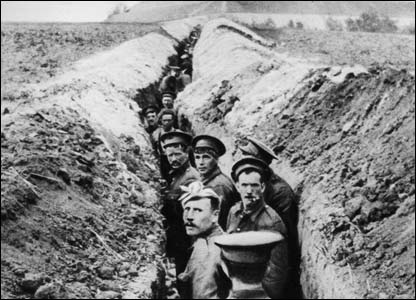 dominant view during the war and throughout most of the 1920s. But there was a minority view of the war during the same period that saw it as senseless slaughter inflicted by an incompetent military leadership. In the 1930s this second view gained ascendancy. World War II took center stage in the 1940s and 1950s, but since the 1960s the senseless slaughter view is almost universally held in Great Britain--save among academic military historians who have been influenced by Fritz Fischer's findings of Germany's bellicose intentions prior to 1914 and who have a greater appreciation for British generalship. As we approach centennial commemorations of WWI, Hochschild predicts that the competition between these two views will be on full display.


