Sarah E. Igo reviews Claude S. Fischer's book Made in America in American Prospect, July 15, 2010. "A half-century ago," says Igo, "writing in the crucible of the early Cold War, American historians were convinced that something ran deep among U.S. citizens linking them to one another--a national personality or fundamental essence that made Americans American. . . ."
Igo isn't quite convinced. "Concerned as it is with the contours of American character as well as culture, it is hard to read Fischer's book as other than an argument for consensus history." Still she finds quite a bit to praise in this sprawling book.
Showing posts with label American History. Show all posts
Showing posts with label American History. Show all posts
Sunday, July 25, 2010

Friday, July 23, 2010
History for the Public, or, Does the Center Hold?
Randall Stephens
NYU professor of history Thomas Bender's engaging on-line essay, "Historians in Public," at the SSRC has been making the rounds. He notes the worries of historians and social scientists, who think "that academic intellect has turned inward, cutting itself off from a role in public life."
Says Bender: "In the 1980s and 1990s instead of talk about and inquiry into “the public,” there was talk of publics, alternative publics, counter-publics, a black public sphere, and more. The list got pretty long, but the public dissolved in this otherwise invaluable historiography of the 1980s and 1990s. There was no United States. History was all parts, no whole. Bookstores organized American history by these identity-driven markets, often with no place for general histories. The challenge not taken up was how to narrate a whole made up of diverse and unequal parts. . . . Historians must bring the state back into relation to society, and along the way they need to rediscover the public. It will be, however, very different from [w]hat the early AHA . . . had in mind. And historians must make themselves a part of that public."
Unlike earlier calls for a unified history, this doesn't sound like a canon shot on the battlefield of the culture war. Though Bender's recommendations do bare some resemblance to those the late Arthur Schlesinger made in his 1991/1998 The Disuniting of America: Reflections on a Multicultural Society. Schlesinger's polemic makes what Bender writes look almost tame, though. And, of course, Schlesinger was writing about the nature and function of American identity.
Here's Schlesinger: "[P]ressed too far, the cult of ethnicity has had bad consequences too. The new ethnic gospel rejects the unifying vision of individuals from all nations melted into a new race. Its underlying philosophy is that America is not a nation of individuals at all but a nation of groups, that ethnicity is the defining experience for Americans, that ethnic ties are permanent and indelible, and that division into ethnic communities establishes the basic structure of American society and the basic meaning of American history." (Disuniting of America, 20-21.)
NYU professor of history Thomas Bender's engaging on-line essay, "Historians in Public," at the SSRC has been making the rounds. He notes the worries of historians and social scientists, who think "that academic intellect has turned inward, cutting itself off from a role in public life."

Says Bender: "In the 1980s and 1990s instead of talk about and inquiry into “the public,” there was talk of publics, alternative publics, counter-publics, a black public sphere, and more. The list got pretty long, but the public dissolved in this otherwise invaluable historiography of the 1980s and 1990s. There was no United States. History was all parts, no whole. Bookstores organized American history by these identity-driven markets, often with no place for general histories. The challenge not taken up was how to narrate a whole made up of diverse and unequal parts. . . . Historians must bring the state back into relation to society, and along the way they need to rediscover the public. It will be, however, very different from [w]hat the early AHA . . . had in mind. And historians must make themselves a part of that public."
Unlike earlier calls for a unified history, this doesn't sound like a canon shot on the battlefield of the culture war. Though Bender's recommendations do bare some resemblance to those the late Arthur Schlesinger made in his 1991/1998 The Disuniting of America: Reflections on a Multicultural Society. Schlesinger's polemic makes what Bender writes look almost tame, though. And, of course, Schlesinger was writing about the nature and function of American identity.
Here's Schlesinger: "[P]ressed too far, the cult of ethnicity has had bad consequences too. The new ethnic gospel rejects the unifying vision of individuals from all nations melted into a new race. Its underlying philosophy is that America is not a nation of individuals at all but a nation of groups, that ethnicity is the defining experience for Americans, that ethnic ties are permanent and indelible, and that division into ethnic communities establishes the basic structure of American society and the basic meaning of American history." (Disuniting of America, 20-21.)
Tuesday, July 20, 2010
Their D-I-V-O-R-C-E: Mad Men, Infidelity, and Life in the 1960s
Randall J. Stephens
Some of us go around the world three times, divorce, remarry, divorce again, part with our children, make and waste a fortune, and coming back to our beginnings we find the same faces at the same windows, buy our cigarettes and newspapers from the same old man, say good morning to the same elevator operator, good night to the same desk clerk, to all those who seem, as Johnson did, driven into life by misfortune like nails into a floor.
-John Cheever, The Wapshot Scandal (Harper & Row, 1964)
The suburbs of New York City in the 1950s were a homogenous and extended community held together by common interests: children, sports, adultery, and lots of social drinking
-Susan Cheever, Home Before Dark: A Personal Memoir of John Cheever by His Daughter (Houghton Mifflin, 1984)
Frank could not escape the impression that she was asking him to get a divorce. Meanwhile, our advisory capacity in Vietnam was beginning to stink and the market was frightened, frightened yet excited by the expanding war. Basically business was uneasy with Kennedy; there was something unconvincing about him.
-John Updike, Couples (Ballantine Books, 1968)
Our D-I-V-O-R-C-E; becomes final today Me and little J-O-E will be goin' away I love you both and it will be pure H-E double L for me Oh, I wish that we could stop this D-I-V-O-R-C-E.
D-I-V-O-R-C-E, recorded by Tammy Wynette (1968)
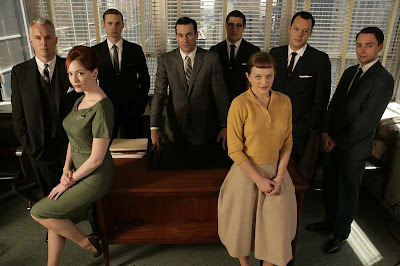
More heavy drinking, more chain smoking, more prefeminist barbarity, more impeccably dressed businessmen, and woman. Mad Men, season 4, is kicking off on Sunday night.

Benjamin Schwarz wrote an insightful, appropriately skeptical piece on the series in The Atlantic back in the fall. Among other things Schwarz wondered about some of the over-the-top boorishness on display, condescending social commentary, and the overall historical accuracy of this "megamovie."
Watching the program, which I'll admit I'm a big fan of, has amazed and perplexed me. (How did the production crew get the colors and the tone just right? Scenes often look like staged advertisements from LIFE or Look Magazine.) Mad Men's interiors--wood paneling, ab-ex paintings, and sleek modernist surfaces--is as nearly as cool as the set of a Jacques Tati flick. The "lush styling and art direction," wrote Schwarz, "which make the series eye candy for its (again) target audience, already in thrall to the so-called mid-century-modern aesthetic—-an appeal that’s now further fueled by the slimline suit/pencil skirt marketing tie-in with Banana Republic, that canny purveyor of upper-mass-market urbanity."
How about the behavior, attitudes, and values of the characters? How does America in the early 1960s compare to America in 2010? The latter seems to be one of the chief questions the program raises. (At least for me, as a nerdy historian.) See, for instance, this John McWhorter piece from The New Republic, "Mad Men In a Good Place: How Did People Sound in 1963?" September 1, 2009. (Did they sound different after 1964? I'm wondering if a Beatles episode might feature Fab Four music. Doubtful. Would cost a fortune.)
And what about the infidelity on parade? Lead ad man Don Draper is a whiskey-soaked, feral Don Juan. Couples on the show occasional make fools of themselves in drunken revelry. Many of the chief men and women have had shaky relationships, boozing it up and forgetting their vows. One agent sleeps in his office after his wife discovers his alcohol-fueled, one-night stand with a secretary. Nearly all of the main male characters are unfaithful. Divorce, though not easy to obtain, is an ever-present option.
So what did the divorce rate look like in the swinging sixties? Brown University historian James Patterson notes that a significant rise in divorce rates seriously affected American families from the mid-sixties on. "Divorce rates per 1,000 of population doubled--from 2.5 per 1,000 people in 1965 to a peak of between 5 and 5.3 per 1,000 between 1976 and 1985."[1] Indeed, the divorce rate rocketed up 100% from '63 to '75. The current rate is 3.5 per 1,000 population.
What about infidelity? Is that more difficult to measure? David Gudelunas observes that we can gauge some national opinions by looking at letters to advice columnists. "The most frequent complaint from women in the 1960s was their cheating husbands," notes Gudelunas.[2] Polls and social science research from the day could also reveal much.
All that is to say that the show has made me more and more curious about how even the recent past can look decidedly strange, remote through the eyes of the present. Fun stuff.
On Sunday night when episode one of season four airs, I'll have my trusty DVD recorder at the ready. (A device, by the way, of pure science fiction by the standards of 1964.)
[1] James T. Patterson, Restless Giant: The United States from Watergate to Bush v. Gore (Oxford University Press, 2005), 50.
[2] David Gudelunas, Confidential to America: Newspaper Advice Columns and Sexual Education (Transaction, 2008), 112.
Some of us go around the world three times, divorce, remarry, divorce again, part with our children, make and waste a fortune, and coming back to our beginnings we find the same faces at the same windows, buy our
 cigarettes and newspapers from the same old man, say good morning to the same elevator operator, good night to the same desk clerk, to all those who seem, as Johnson did, driven into life by misfortune like nails into a floor.
-John Cheever, The Wapshot Scandal (Harper & Row, 1964)
The suburbs of New York City in the 1950s were a homogenous and extended community held together by common interests: children, sports, adultery, and lots of social drinking
-Susan Cheever, Home Before Dark: A Personal Memoir of John Cheever by His Daughter (Houghton Mifflin, 1984)
Frank could not escape the impression that she was asking him to get a divorce. Meanwhile, our advisory capacity in Vietnam was beginning to stink and the market was frightened, frightened yet excited by the expanding war. Basically business was uneasy with Kennedy; there was something unconvincing about him.
-John Updike, Couples (Ballantine Books, 1968)
Our D-I-V-O-R-C-E; becomes final today Me and little J-O-E will be goin' away I love you both and it will be pure H-E double L for me Oh, I wish that we could stop this D-I-V-O-R-C-E.
D-I-V-O-R-C-E, recorded by Tammy Wynette (1968)
More heavy drinking, more chain smoking, more prefeminist barbarity, more impeccably dressed businessmen, and woman. Mad Men, season 4, is kicking off on Sunday night.

Benjamin Schwarz wrote an insightful, appropriately skeptical piece on the series in The Atlantic back in the fall. Among other things Schwarz wondered about some of the over-the-top boorishness on display, condescending social commentary, and the overall historical accuracy of this "megamovie."
Watching the program, which I'll admit I'm a big fan of, has amazed and perplexed me. (How did the production crew get the colors and the tone just right? Scenes often look like staged advertisements from LIFE or Look Magazine.) Mad Men's interiors--wood paneling, ab-ex paintings, and sleek modernist surfaces--is as nearly as cool as the set of a Jacques Tati flick. The "lush styling and art direction," wrote Schwarz, "which make the series eye candy for its (again) target audience, already in thrall to the so-called mid-century-modern aesthetic—-an appeal that’s now further fueled by the slimline suit/pencil skirt marketing tie-in with Banana Republic, that canny purveyor of upper-mass-market urbanity."
How about the behavior, attitudes, and values of the characters? How does America in the early 1960s compare to America in 2010? The latter seems to be one of the chief questions the program raises. (At least for me, as a nerdy historian.) See, for instance, this John McWhorter piece from The New Republic, "Mad Men In a Good Place: How Did People Sound in 1963?" September 1, 2009. (Did they sound different after 1964? I'm wondering if a Beatles episode might feature Fab Four music. Doubtful. Would cost a fortune.)
And what about the infidelity on parade? Lead ad man Don Draper is a whiskey-soaked, feral Don Juan. Couples on the show occasional make fools of themselves in drunken revelry. Many of the chief men and women have had shaky relationships, boozing it up and forgetting their vows. One agent sleeps in his office after his wife discovers his alcohol-fueled, one-night stand with a secretary. Nearly all of the main male characters are unfaithful. Divorce, though not easy to obtain, is an ever-present option.

So what did the divorce rate look like in the swinging sixties? Brown University historian James Patterson notes that a significant rise in divorce rates seriously affected American families from the mid-sixties on. "Divorce rates per 1,000 of population doubled--from 2.5 per 1,000 people in 1965 to a peak of between 5 and 5.3 per 1,000 between 1976 and 1985."[1] Indeed, the divorce rate rocketed up 100% from '63 to '75. The current rate is 3.5 per 1,000 population.
What about infidelity? Is that more difficult to measure? David Gudelunas observes that we can gauge some national opinions by looking at letters to advice columnists. "The most frequent complaint from women in the 1960s was their cheating husbands," notes Gudelunas.[2] Polls and social science research from the day could also reveal much.
All that is to say that the show has made me more and more curious about how even the recent past can look decidedly strange, remote through the eyes of the present. Fun stuff.
On Sunday night when episode one of season four airs, I'll have my trusty DVD recorder at the ready. (A device, by the way, of pure science fiction by the standards of 1964.)
[1] James T. Patterson, Restless Giant: The United States from Watergate to Bush v. Gore (Oxford University Press, 2005), 50.
[2] David Gudelunas, Confidential to America: Newspaper Advice Columns and Sexual Education (Transaction, 2008), 112.
Sunday, July 18, 2010
Cincinnati Daguerreotype Time Machine, 1848
Randall Stephens
What if we could see, in vivid detail, the world of a mid-19th century American city? We can. Sort of.
On a sunny Sunday in September 1848, two clever daguerreotypists, Charles Fontayne and William S. Porter, placed their camera on a rooftop next to the Ohio River. From Newport, Kentucky, they captured a sweeping panoramic view of Cincinnati. The massive, detailed image that resulted reveals a bustling western city. The original ranks as one of the Cincinnati Public Library's greatest treasures.
The huge picture contains amazing detail. (See the zoom-in from the YouTube clip embedded here.) Visible in the picture are open windows, a distant clock tower, merchants, free blacks, a railroad station, steamboats, factories, shops, and more. Combine all that visual evidence with the 1850-51 Cincinnati Directory, detail from local papers, booster works of the day, statistical reports, and a full picture emerges.
Wired magazine features the 1848 waterfront daguerreotype in its August 2010 issue. "The panorama could be blown up to 170 by 20 feet without losing clarity," writes Julie Rehmeyer. To reach that level of precision a digital camera version would have to record a staggering 140,000 megapixels per shot. The total stitched-together panorama contains nearly 9-billion pixels. Rehmeyer describes the restoration and stabilization of the plates through the latest technology. Her explanation of the daguerreotype (the latest technology of that day) gives a good sense of how this all worked.

The Cincinnati Library intends to make a zoomable version available on-line next year. Until then, see The University of Rochester and George Eastman House, which has a 180mb version of one part of the Cincinnati Waterfront image on-line. (Warning: That's a massive file.)
I wonder if the zoomable version will be available by the next time I teach my course on American history from 1783-1865. I can see pairing this image up with primary and secondary source materials. Students might answer questions about how the panorama confirms or challenges the reading. What can we learn from the visual record that we can't learn from print? What does the look, design, layout of an America city tell us about this age?
As far as a selection from a primary source . . . any of these would work: James Handasyd Perkins, Annals of the West: Embracing a Concise Account of Principal Events . . . (1852), Charles Cist, The Cincinnati Miscellany (1846), or Eliza R. Steele, A Summer Journey in the West (1841). On the secondary source side: Daniel Walker Howe, What Hath God Wrought: The Transformation of America, 1815-1848 (Oxford, 2007), Leo Damrosch, Tocqueville's Discovery of America (Farrar, Straus and Giroux, 2010), or David S. Reynolds, Waking Giant: America in the Age of Jackson (Harper Perennial, 2009).
Thursday, July 8, 2010
Publishing Mark Twain's Long-Awaited Autobiography
Randall Stephens
W. D. Howells wrote his long-time friend Mark Twain: "I wonder why we hate the past so?" Twain snapped back "It's so damned humiliating." Mark Twain had a few choice things to say about history.
"I said there was but one solitary thing about the past worth remembering, and that was the fact that it is past-can't be restored."*
Elsewhere he paraphrased Herdotus: "Very few things happen at the right time, and the rest do not happen at all. The conscientious historian will correct these defects."
Twain was a cynic. A very funny one at that. His views on religion were so volatile in his day--and he feared enough for his own reputation and for that of his immediate family--that he chose not to air them. Though a skeptic, he made observations like this: "All that is great and good in our particular civilization came straight from the hand of Jesus Christ." The bloody theology of Christianity along with its particularity, in his view, was repulsive. He confided to his notebook in 1896: "If Christ was God, He is in the attitude of One whose anger against Adam has grown so uncontrollable in the course of . . . If Christ was God, then the crucifixion is without dignity. It is merely ridiculous, for to endure several hours."
In the autobiography he worked on, Twain meditated on religion, writing, the West, his acquaintances, and more. (See the PBS Newshour segment on the autobio embedded here.)
The editors of the Mark Twain Project at Berkeley have their hands full. The projects website explains:
Twain stipulated that the autobiography could be published one-hundred years after his death. "He used the autobiography as a chance to disburden himself of a lot of feeling," says Benjamin Griffin in the Newshour piece. "He left this out of the final version of the autobiography." For example, as a staunch anti-imperialist, Twain took aim at Teddy Roosevelt for his role in the massacre of Filipino guerrillas during the Spanish-American War.
I look forward to reading the completed version. (Or at least thumbing through it.) Not a light read, I'm sure.
W. D. Howells wrote his long-time friend Mark Twain: "I wonder why we hate the past so?" Twain snapped back "It's so damned humiliating." Mark Twain had a few choice things to say about history.
"I said there was but one solitary thing about the past worth remembering, and that was the fact that it is past-can't be restored."*
Elsewhere he paraphrased Herdotus: "Very few things happen at the right time, and the rest do not happen at all. The conscientious historian will correct these defects."
Twain was a cynic. A very funny one at that. His views on religion were so volatile in his day--and he feared enough for his own reputation and for that of his immediate family--that he chose not to air them. Though a skeptic, he made observations like this: "All that is great and good in our particular civilization came straight from the hand of Jesus Christ." The bloody theology of Christianity along with its particularity, in his view, was repulsive. He confided to his notebook in 1896: "If Christ was God, He is in the attitude of One whose anger against Adam has grown so uncontrollable in the course of . . . If Christ was God, then the crucifixion is without dignity. It is merely ridiculous, for to endure several hours."
In the autobiography he worked on, Twain meditated on religion, writing, the West, his acquaintances, and more. (See the PBS Newshour segment on the autobio embedded here.)
The editors of the Mark Twain Project at Berkeley have their hands full. The projects website explains:
Housed in the midst of the archive is the Mark Twain Project, a major editorial and publishing program of The Bancroft Library. Its six resident editors are at work on a comprehensive scholarly edition of all of Mark Twain's private papers and published works. More than thirty of an estimated seventy volumes in The Works and Papers of Mark Twain are currently available, all published by the University of California Press.
Twain stipulated that the autobiography could be published one-hundred years after his death. "He used the autobiography as a chance to disburden himself of a lot of feeling," says Benjamin Griffin in the Newshour piece. "He left this out of the final version of the autobiography." For example, as a staunch anti-imperialist, Twain took aim at Teddy Roosevelt for his role in the massacre of Filipino guerrillas during the Spanish-American War.
"[Roosevelt] knew perfectly well that to pen 600 helpless and weaponless savages in a hole like rats in a trap and massacre them in detail during a stretch of a day-and-a-half from a safe position on the heights above was no brilliant feat of arms. He knew perfectly well that our uniformed assassins had not upheld the honor of the American flag."
I look forward to reading the completed version. (Or at least thumbing through it.) Not a light read, I'm sure.
Thursday, July 1, 2010
July 4, 1826
Randall Stephens
It was fifty years to the day after the 13 colonies declared independence from Great Britain.
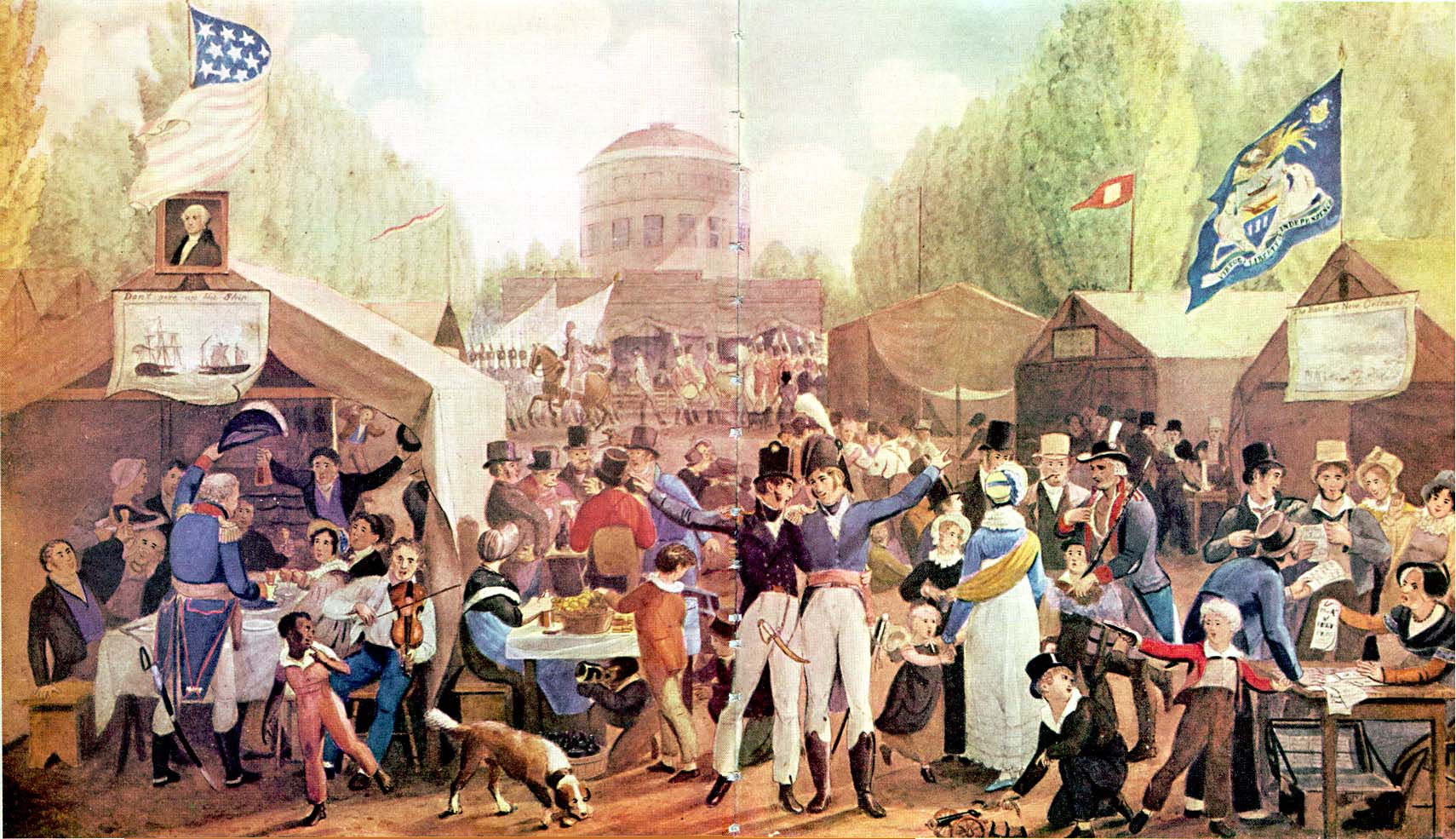
President John Quincy Adams wrote in his diary about the festivities in Washington. "The volunteer companies assembled on the square," he observed, "fronting the house and paid the passing salute by marching through the yard."
News traveled slowly over bad roads. Members of congress knew of Jefferson's troubles, but the severity of his situation was unclear. Few could have guessed that Jefferson's one-time rival and on-again/off-again friend John Adams was also in his last throes. Thomas Jefferson and John Adams died on that hot July day.
Four days later John Quincy received a batch of letters. One brought bad news. A missive "from my brother, written on the morning of the 4th, announcing that, in the opinion of those who surrounded my father's couch, he was rapidly sinking; that they were sending an express for my son in Boston, who might perhaps arrive in time to receive his last breath. The third was from my brother's wife to her daughter Elizabeth to the same purport, and written in much distress." On his way north to Boston, while in Waterloo, MD, he heard that his father had died. It was July 9th. He was stricken with grief. "My father had nearly closed the ninety-first year of his life," he confided to his diary, "a life illustrious in the annals of his country and of the world."
Plenty of Americans in 1826 had something to say about the death of two lions of the Revolution. Prone to view the world through the eyes of faith, and to read signs in the sky and on the ground, newspaper editors, clergy, and laypeople were astounded. On July 11 the Massachusetts Salem Gazette lamented "We know not in what language to express ourselves in announcing . . . another event which has transpired to render the late glorious anniversary, the national jubilee, in some respects the most memorable day in the history of our country." That was no hollow encomium. It rang true across the young nation. The New York Commercial Advertiser rhapsodized: "it seems as though Divine Providence had determined that the spirits of these great men, which were kindled at the same altar, and glowed with the same patriotic fervor . . . should be united in death, and travel into the unknown regions of eternity together!"

Some years back Margaret P. Battin wrote in Historically Speaking about the strange coincidence of Jefferson's and Adam's deaths on the same day. "Although the fact that Adams and Jefferson died the same day is taught to practically every schoolchild, asking why is not," Battin noted. "What could explain this? There are at least six principal avenues to explore, but all of them raise further issues." She then offered some of the explanations given over the ages for their demise on that same anniversary.
It makes me wonder about the comparison and contrast between our age and the beginning of the Jacksonian era. Do Americans now have similar ideas linking nation, patriotism, and providence? Do Americans esteem their leaders and the political giants of our day in any way like they did 184 years ago? How have citizens understood God and country from one era to the next?
It was fifty years to the day after the 13 colonies declared independence from Great Britain.
President John Quincy Adams wrote in his diary about the festivities in Washington. "The
 volunteer companies assembled on the square," he observed, "fronting the house and paid the passing salute by marching through the yard."
Arriving at the door of the Capitol, I was there met by Mr. Anderson, the Comptroller, with whom we entered the hall of the House of Representatives. The Reverend Mr. Ryland made an introductory prayer.
Joseph Anderson, the Comptroller, read the Declaration of Independence; Walter Jones delivered an oration commemorative of the fiftieth anniversary; the Reverend Mr. Post, Chaplain of H. R. U. S., made a concluding prayer.
After which, Governor Barbour delivered an address to the citizens assembled, soliciting subscriptions for the relief of Mr. Jefferson. . .
News traveled slowly over bad roads. Members of congress knew of Jefferson's troubles, but the
 severity of his situation was unclear. Few could have guessed that Jefferson's one-time rival and on-again/off-again friend John Adams was also in his last throes. Thomas Jefferson and John Adams died on that hot July day.
Four days later John Quincy received a batch of letters. One brought bad news. A missive "from my brother, written on the morning of the 4th, announcing that, in the opinion of those who surrounded my father's couch, he was rapidly sinking; that they were sending an express for my son in Boston, who might perhaps arrive in time to receive his last breath. The third was from my brother's wife to her daughter Elizabeth to the same purport, and written in much distress." On his way north to Boston, while in Waterloo, MD, he heard that his father had died. It was July 9th. He was stricken with grief. "My father had nearly closed the ninety-first year of his life," he confided to his diary, "a life illustrious in the annals of his country and of the world."
He had served to great and useful purpose his nation, his age, and his God. He is gone, and may the blessing of Almighty Grace have attended him to his account! I say not, May my last end be like his!—it were presumptuous. The time, the manner, the coincidence with the decease of Jefferson, are visible and palpable marks of Divine favor, for which I would  humble myself in grateful and silent adoration before the Ruler of the Universe. For myself, all that I dare to ask is, that I may live the remnant of my days in a manner worthy of him from whom I came, and, at the appointed hour of my Maker, die as my father has died, in peace with God and man, sped to the regions of futurity with the blessings of my fellow-men.
 humble myself in grateful and silent adoration before the Ruler of the Universe. For myself, all that I dare to ask is, that I may live the remnant of my days in a manner worthy of him from whom I came, and, at the appointed hour of my Maker, die as my father has died, in peace with God and man, sped to the regions of futurity with the blessings of my fellow-men.
Plenty of Americans in 1826 had something to say about the death of two lions of the Revolution. Prone to view the world through the eyes of faith, and to read signs in the sky and on the ground, newspaper editors, clergy, and laypeople were astounded. On July 11 the Massachusetts Salem Gazette lamented "We know not in what language to express ourselves in announcing . . . another event which has transpired to render the late glorious anniversary, the national jubilee, in some respects the most memorable day in the history of our country." That was no hollow encomium. It rang true across the young nation. The New York Commercial Advertiser rhapsodized: "it seems as though Divine Providence had determined that the spirits of these great men, which were kindled at the same altar, and glowed with the same patriotic fervor . . . should be united in death, and travel into the unknown regions of eternity together!"

Some years back Margaret P. Battin wrote in Historically Speaking about the strange coincidence of Jefferson's and Adam's deaths on the same day. "Although the fact that Adams and Jefferson died the same day is taught to practically every schoolchild, asking why is not," Battin noted. "What could explain this? There are at least six principal avenues to explore, but all of them raise further issues." She then offered some of the explanations given over the ages for their demise on that same anniversary.
It makes me wonder about the comparison and contrast between our age and the beginning of the Jacksonian era. Do Americans now have similar ideas linking nation, patriotism, and providence? Do Americans esteem their leaders and the political giants of our day in any way like they did 184 years ago? How have citizens understood God and country from one era to the next?
Wednesday, June 16, 2010
A Crosspost on Presidential Speeches on Energy from the Miller Center of Public Affairs
Lauren Dunsmore
University of Virginia’s Miller Center of Public Affairs
President Obama addressed the nation yesterday about the oil spill in t he Gulf of Mexico. He also talked about reducing America’s dependence on foreign oil and fossil fuels, a theme in many presidential remarks.
In a 1977 speech on energy, Carter says we will have to drill more offshore wells if we don't conserve.
Ford had similar remarks on May 27, 1975. Check out this clip in which he says Congress has done little or nothing to decrease America’s dependence on foreign oil.
Click here to see how past presidents—from JFK to Reagan—addressed domestic crises during their administrations.
University of Virginia’s Miller Center of Public Affairs
President Obama addressed the nation yesterday about the oil spill in t
 he Gulf of Mexico. He also talked about reducing America’s dependence on foreign oil and fossil fuels, a theme in many presidential remarks.
In a 1977 speech on energy, Carter says we will have to drill more offshore wells if we don't conserve.
Ford had similar remarks on May 27, 1975. Check out this clip in which he says Congress has done little or nothing to decrease America’s dependence on foreign oil.
Click here to see how past presidents—from JFK to Reagan—addressed domestic crises during their administrations.
Monday, June 7, 2010
Dispatches from the Historical Society Conference, Day 3: Plenary Session on America's Enduring Two-Party System
Randall Stephens
The Historical Society's 2010 conference came to a close at George Washington University with a final plenary session on Saturday night dealing with the nature of America's two-party system. (Listen to the audio file embedded below. It will take a moment to load. The quality is not the greatest, but the words can be made out OK.) Heather Cox Richardson (University of Massachusetts Amherst) introduced Michael Barone (American Enterprise Institute), who spoke on “The Enduring Character of America’s Political Parties in Times of Continual Change.” These two parties, ancient in the world of modern politics, have long diverged sharply, said Barone. Some deeply consistent themes have defined the Democratic and Republican parties since the mid-19th century. The two distinct parties represent very different constituencies and have, since the 19th-century, upheld rather distinct political ideas. For instance, Barone described the outsider aspect of the Democratic Party, which tended to represent immigrants, saloon keepers, and many on the margins. The party of Roosevelt, populated by interest groups and factions, Barone remarked, lacked the cohesion of the Republican Party.
Commenters Sean Wilentz (Princeton University) and Leo Ribuffo (George Washington University) both praised Barone's extensive knowledge of political history, but each had serious critiques of Barone's key arguments. Ribuffo thought Barone overemphasized the differences between the parties. The two parties were, argued Ribuffo, less like a donkey and an elephant and more like kissing cousins, even incestuous cousins at times. Wilentz argued that Barone had not paid appropriate attention to class. Wilentz and Ribuffo also questioned Barone's insider-outsider thesis. The white democracy of the South hardly fit that pattern. At other points the commenters took issue with the continuities Barone saw.
The lively discussion was a fitting end to an intellectually engaging, vibrant conference that gave attendees much to ponder about the state of the profession and the future of historical inquiry.
The Historical Society's 2010 conference came to a close at George Washington University with a final plenary session on Saturday night dealing with the
 nature of America's two-party system. (Listen to the audio file embedded below. It will take a moment to load. The quality is not the greatest, but the words can be made out OK.) Heather Cox Richardson (University of Massachusetts Amherst) introduced Michael Barone (American Enterprise Institute), who spoke on “The Enduring Character of America’s Political Parties in Times of Continual Change.” These two parties, ancient in the world of modern politics, have long diverged sharply, said Barone. Some deeply consistent themes have defined the Democratic and Republican parties since the mid-19th century. The two distinct parties represent very different constituencies and have, since the 19th-century, upheld rather distinct political ideas. For instance, Barone described the outsider aspect of the Democratic Party, which tended to represent immigrants, saloon keepers, and many on the margins. The party of Roosevelt, populated by interest groups and factions, Barone remarked, lacked the cohesion of the Republican Party.
Commenters Sean Wilentz (Princeton University) and Leo Ribuffo (George Washington University) both praised Barone's extensive knowledge of political history, but each had serious critiques of Barone's key arguments. Ribuffo thought Barone overemphasized the differences between the parties. The two parties were, argued Ribuffo, less like a donkey and an elephant and more like kissing cousins, even incestuous cousins at times. Wilentz argued that Barone had not paid appropriate attention to class. Wilentz and Ribuffo also questioned Barone's insider-outsider thesis. The white democracy of the South hardly fit that pattern. At other points the commenters took issue with the continuities Barone saw.
The lively discussion was a fitting end to an intellectually engaging, vibrant conference that gave attendees much to ponder about the state of the profession and the future of historical inquiry.
Monday, May 10, 2010
Roanoke Roundup
Randall Stephens
William Stith, History of the Firft Discovery and Settlement of Virginia (Williamsburg, 1747).
This Colony chofe Roanoke, an Ifland at the Mouth of Albermarle Sound, for the Place of their Habitation; and their chief Employment was to reconnoitre and view the Country. Their fartheft Difcovery to the Southward was Seeotan, an Indian Town, by their Reckoning, eighty Leagues from Roanoke, lying up between the Rivers Pampticoe and Neus, in North-Carolina. To the Northward they went an hundred and thirty Miles to the Chefapeaks, a Nation of Indians, feared on a fmall River, to the South of our Bay, now cabled Elfabeth River, from whom, as thefe firft Difcoverers tell us, the Bay itfelf took its Name. >>>
Steven Morris, "Bideford Mayor Hunts US 'Lost Colony' Clues," Guardian, May 6, 2010.
A mayor in north Devon is attempting to help rewrite American history by proving that people from his small port town settled in the US 30 years before the Pilgrim Fathers set sail. Andy Powell hopes to find funds for DNA tests that might help demonstrate Bideford's "pivotal" role in the history of modern America. If he can find the proof, the town might find itself at the centre of a tourism boom. >>>
"Local Legacies: The Lost Colony," Library of Congress.
The mystery of the lost colony of Roanoke Island has been passed down from generation to generation since their discovered disappearance in 1590-three years after the settlers from England landed. Did the 120 men, women, and children assimilate with the friendly Croatoan natives or the Chesapeake tribe? Or were they massacred by the unfriendly Wanchese tribe? This legend gains more poignancy when you consider that Virginia Dare, the first child born of English parentage in America, was among these brave pioneers. >>>
Drew DeSilver, "A Kingdom Strange: A new look at the Lost Colony of Roanoke" (a review of James Horn's new book), Seattle Times, May 1, 2010.
For a people who celebrate success as much as Americans do, we have something of a romantic affinity for failure. The Confederacy may have fallen, but as the Lost Cause it inspired, among other things, "Gone With the Wind." The Chicago Cubs have legions of fans who've never set foot inside Wrigley Field; they love the team not despite its decades of futility but largely because of them. More than 400 years after it disappeared, the Lost Colony of Roanoke, in what is now North Carolina's Outer Banks, continues to fascinate. >>>
Greg Schneider, "Book review: 'A Kingdom Strange,' by James Horn," Washington Post, April 25, 2010.
In 1587, 20 years before Jamestown, English settlers founded a colony on Roanoke Island in the Outer Banks of North Carolina. This wasn't some hardened outpost of soldiers. It was families, husbands with pregnant wives, fathers with young sons -- 118 people in all. They built a fort, befriended some of the natives and produced the first English baby born in the New World: Virginia Dare. And within three years, they all disappeared. The fate of the Lost Colony is a mystery at the heart of the nation's founding, chock full of odd characters, conspiracy theories, strange turns of events -- even enigmatic carvings left behind on tree trunks. >>>
William Stith, History of the Firft Discovery and Settlement of Virginia (Williamsburg, 1747).
This Colony chofe Roanoke, an Ifland at the Mouth of Albermarle Sound, for the Place of their Habitation; and their chief Employment was to reconnoitre and view the Country. Their fartheft Difcovery to the
Southward was Seeotan, an Indian Town, by their Reckoning, eighty Leagues from Roanoke, lying up between the Rivers Pampticoe and Neus, in North-Carolina. To the Northward they went an hundred and thirty Miles to the Chefapeaks, a Nation of Indians, feared on a fmall River, to the South of our Bay, now cabled Elfabeth River, from whom, as thefe firft Difcoverers tell us, the Bay itfelf took its Name. >>>Steven Morris, "Bideford Mayor Hunts US 'Lost Colony' Clues," Guardian, May 6, 2010.
A mayor in north Devon is attempting to help rewrite American history by proving that people from his small port town settled in the US 30 years before the Pilgrim Fathers set sail. Andy Powell hopes to find funds for DNA tests that might help demonstrate Bideford's "pivotal" role in the history of modern America. If he can find the proof, the town might find itself at the centre of a tourism boom. >>>
"Local Legacies: The Lost Colony," Library of Congress.
The mystery of the lost colony of Roanoke Island has been passed down from generation to generation since their discovered disappearance in 1590-three years after the settlers from England landed. Did the 120 men, women, and children assimilate with the friendly Croatoan natives or the Chesapeake tribe? Or were they massacred by the unfriendly Wanchese tribe? This legend gains more poignancy when you consider that Virginia Dare, the first child born of English parentage in America, was among these brave pioneers. >>>
Drew DeSilver, "A Kingdom Strange: A new look at the Lost Colony of Roanoke" (a review of James Horn's new book), Seattle Times, May 1, 2010.
For a people who celebrate success as much as Americans do, we have something of a romantic affinity for failure. The Confederacy may have fallen, but as the Lost Cause it inspired, among other things, "Gone With the Wind." The Chicago Cubs have legions of fans who've never set foot inside Wrigley Field; they love the team not despite its decades of futility but largely because of them. More than 400 years after it disappeared, the Lost Colony of Roanoke, in what is now North Carolina's Outer Banks, continues to fascinate. >>>
Greg Schneider, "Book review: 'A Kingdom Strange,' by James Horn," Washington Post, April 25, 2010.
In 1587, 20 years before Jamestown, English settlers founded a colony on Roanoke Island in the Outer Banks of North Carolina. This wasn't some hardened outpost of soldiers. It was families, husbands with pregnant wives, fathers with young sons -- 118 people in all. They built a fort, befriended some of the natives and produced the first English baby born in the New World: Virginia Dare. And within three years, they all disappeared. The fate of the Lost Colony is a mystery at the heart of the nation's founding, chock full of odd characters, conspiracy theories, strange turns of events -- even enigmatic carvings left behind on tree trunks. >>>
Wednesday, April 28, 2010
Eric Arnesen on Brinkley's FDR
Randall Stephens
Franklin D. Roosevelt was stricken with polio in 1921. From then on he could only walk with the help of others or the use of crutches. That did not keep him from thinking about feet and walking in politically metaphorical terms. "A radical is a man with both feet firmly planted—in the air," he told a radio audience in the desperate year of 1939. "A conservative is a man with two perfectly good legs who, however, has never learned to walk forward. A reactionary is a somnambulist walking backwards. A liberal is a man who uses his legs and his hands at the behest . . . of his head." Critics howled with disbelief. The federal government was treading all over regular Americans, walking up one side of the common man and down the other.
Eric Arnesen reviews Alan Brinley's biography of FDR over at the Chicago Tribune. He begins with the words of one vociferous critic, who worries that Big Government boots are going to walk all over liberty.
Eric Arnesen, Franklin Delano Roosevelt
By Alan Brinkley
Oxford University Press, 2009, $12.95, 129 pages
At a time of crisis in the American economy, one critic of federal programs charges the administration with stumbling “into philosophies which lead to the surrender of freedom.” It is a “false Liberalism that interprets itself into government dictation,” poisoning “political equality” and “equality of opportunity.” The policies pursed by the administration constitute “the road not to liberty but to less liberty.” What is needed is the “release of the dynamic forces in initiative and enterprise” which “are alone the methods by which these solutions can be found and the purpose of American life assured.”
What had so exercised this critic? The rescue of AIG, the financial sector, and the domestic auto industry? The health care bill that recently emerged triumphant by the narrowest of legislative margins? President Barack Obama’s recess appointments? And just who was so exercised? The Republican National Committee chairman Michael Steele? Former Alaska governor Sarah Palin? A libertarian activist? A tea party-er?
This time, President Obama is off the hook. The contemporary ring of the attack notwithstanding, this denunciation of liberalism and federal authority and celebration of free enterprise is over seventy-five years old. The critic was former President Herbert Hoover; the year 1934. And what so agitated him was President Franklin D. Roosevelt and his New Deal. Just as Obama has his political enemies to the Right, so too did Roosevelt.
Along with Washington and Lincoln, political historian Alan Brinkley observes, Franklin Roosevelt remains for most Americans “part of the triumvirate of our greatest leaders.” The only political figure to be elected president four times, FDR had his work cut out for him: he not only presided over the nation’s most severe economic crisis ever but he successfully led the United States to victory in a bloody world war that threatened to extinguish democracy around the globe. His legacy during “dark and dangerous years” was “extraordinary,” Brinkley reminds us. “No president since the nation’s founding has done more to shape the character of American government.”
Not surprisingly, then, FDR has attracted considerable attention from historians over the decades. From Arthur M. Schlesinger and James McGregor Burns in the 1950s to Conrad Black, Jean Edward Smith, and H.W. Brands in the early 21st century, the 32nd president has been the subject of numerous biographies, some multi-volume and many extremely long. For all of the thousands of pages – tens of thousands, actually – devoted to exploring his life, Roosevelt remains, Brinkley argues, an “enigmatic man” who has “defied the efforts of so many people who have hoped to understand him fully.” read more >>>
Franklin D. Roosevelt was stricken with polio in 1921. From then on he could only walk with the help of others or the use of crutches. That did not keep him from thinking about feet and walking in politically metaphorical terms. "A radical
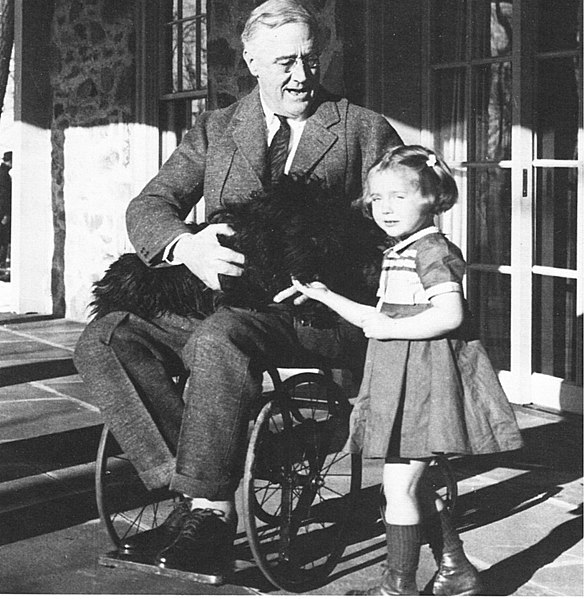 is a man with both feet firmly planted—in the air," he told a radio audience in the desperate year of 1939. "A conservative is a man with two perfectly good legs who, however, has never learned to walk forward. A reactionary is a somnambulist walking backwards. A liberal is a man who uses his legs and his hands at the behest . . . of his head." Critics howled with disbelief. The federal government was treading all over regular Americans, walking up one side of the common man and down the other.
Eric Arnesen reviews Alan Brinley's biography of FDR over at the Chicago Tribune. He begins with the words of one vociferous critic, who worries that Big Government boots are going to walk all over liberty.
Eric Arnesen, Franklin Delano Roosevelt
By Alan Brinkley
Oxford University Press, 2009, $12.95, 129 pages
At a time of crisis in the American economy, one critic of federal programs charges the administration with stumbling “into philosophies which lead to the surrender of freedom.” It is a “false Liberalism that interprets itself into government dictation,” poisoning “political equality” and “equality of opportunity.” The policies pursed by the administration constitute “the road not to liberty but to less liberty.” What is needed is the “release of the dynamic forces in initiative and enterprise” which “are alone the methods by which these solutions can be found and the purpose of American life assured.”
What had so exercised this critic? The rescue of AIG, the financial sector, and the domestic auto industry? The health care bill that recently emerged triumphant by the narrowest of legislative margins? President Barack Obama’s recess appointments? And just
 who was so exercised? The Republican National Committee chairman Michael Steele? Former Alaska governor Sarah Palin? A libertarian activist? A tea party-er?
This time, President Obama is off the hook. The contemporary ring of the attack notwithstanding, this denunciation of liberalism and federal authority and celebration of free enterprise is over seventy-five years old. The critic was former President Herbert Hoover; the year 1934. And what so agitated him was President Franklin D. Roosevelt and his New Deal. Just as Obama has his political enemies to the Right, so too did Roosevelt.
Along with Washington and Lincoln, political historian Alan Brinkley observes, Franklin Roosevelt remains for most Americans “part of the triumvirate of our greatest leaders.” The only political figure to be elected president four times, FDR had his work cut out for him: he not only presided over the nation’s most severe economic crisis ever but he successfully led the United States to victory in a bloody world war that threatened to extinguish democracy around the globe. His legacy during “dark and dangerous years” was “extraordinary,” Brinkley reminds us. “No president since the nation’s founding has done more to shape the character of American government.”
Not surprisingly, then, FDR has attracted considerable attention from historians over the decades. From Arthur M. Schlesinger and James McGregor Burns in the 1950s to Conrad Black, Jean Edward Smith, and H.W. Brands in the early 21st century, the 32nd president has been the subject of numerous biographies, some multi-volume and many extremely long. For all of the thousands of pages – tens of thousands, actually – devoted to exploring his life, Roosevelt remains, Brinkley argues, an “enigmatic man” who has “defied the efforts of so many people who have hoped to understand him fully.” read more >>>
Sunday, March 7, 2010
Rescuing Woodrow Wilson's Reputation
Former president of the Historical Society Eric Arnesen reviews John Milton Cooper's book on Woodrow Wilson in the Chicago Tribune. "Cooper’s strengths," Arnesen observes, "lie in his bringing his subject to life and portraying the world through his eyes. As a study of Wilson’s personal and political life, the meticulously researched 'Woodrow Wilson: A Biography' is unlikely to be surpassed any time soon."

Eric Arnesen's review of Woodrow Wilson: A Biography by John Milton Cooper Jr., Chicago Tribune, March 6, 2010.

Eric Arnesen's review of Woodrow Wilson: A Biography by John Milton Cooper Jr., Chicago Tribune, March 6, 2010.
Wilson President Woodrow Wilson, a confidant confided in his diary shortly after World War I, “will probably go down in history as the greatest figure of his time, and I hope, of all time.” As it turned out, such a prediction could hardly be farther off the mark. Even before the Armistice, Wilson’s political fortunes faltered. The 1918 elections delivered a severe blow, resulting in a Republican sweep. And American participation in his cherished League of Nations – his hope to prevent future wars through collaboration among nations – perished at the hands of Senatorial opponents. Wilsonian internationalism quickly gave way to an intense isolationism that viewed U.S. involvement in World War I as a grave mistake and sought to keep the nation out of the next European war. Wilson’s final years – in office and in retirement – were bitter ones for a man whose grandiose dreams had been utterly dashed.
John Milton Cooper, Jr., a presidential scholar and author of a monumental new biography of the 28th president, seeks to rescue Wilson’s reputation and restore him to his place as one of America’s finest leaders. Wilson was a bold, sophisticated idealist who could be “hardheaded” and pragmatic, he argues; his domestic record in office makes him “one of the greatest legislative leaders ever to occupy the White House.” A man who had given little thought to world affairs became a resolute wartime president whose shortening of the Great War meant that “hundreds of thousands, perhaps millions, of people owed their lives to him.” >>>
John Milton Cooper, Jr., a presidential scholar and author of a monumental new biography of the 28th president, seeks to rescue Wilson’s reputation and restore him to his place as one of America’s finest leaders. Wilson was a bold, sophisticated idealist who could be “hardheaded” and pragmatic, he argues; his domestic record in office makes him “one of the greatest legislative leaders ever to occupy the White House.” A man who had given little thought to world affairs became a resolute wartime president whose shortening of the Great War meant that “hundreds of thousands, perhaps millions, of people owed their lives to him.” >>>
Wednesday, March 3, 2010
Lecture on Abolition and American Culture at Harvard
*
Abolition and American Culture
Alexis de Tocqueville Lecture on American Politics
Harvard University

March 10, 2010
by
Andrew Delbanco
Levi Profess or in the Humanities, Columbia University
Commentary by
John Stauffer
Professor of English and of
African American Studies
Harvard University
Manisha Sinha
Associate Professor of
Afro-American Studies
University of
Massachusetts, Amherst
Wilfred McClay
SunTrust Bank Chair of
Excellence in Humanities at the
University of Tennessee
at Chattanooga
Darryl Pinckney
Novelist, Essayist,
and Critic
Event Details
4:00pm–6:00pm Lecture
7:00-9:30pm Commentary and Rejoinder
Location
Tsai Auditorium (S-010)
Concourse Level 1737
Cambridge Street. Cambridge, MA 02138
Wednesday, February 3, 2010
The Underworld and a Book Series I'd Like to See
Randall Stephens
Over 100 years ago the sociologist Emile Durkheim observed “There is no society known where a more or less developed criminality is not found under different forms. No people exists whose morality is not daily infringed upon. We must therefore call crime necessary and declare that it cannot be non-existent, that the fundamental conditions of social organization, as they are understood, logically imply it.”
Just like a sociologists to make that sort of generalization. "Over the ages, man has . . ." But, he was right, right?
The history of ever-present crime tells us about the parameters of a society and reveals something profound about social structure. But there is also a deeply historical component to it. A criminal act or a perpetrator in one era may also be deemed law-abiding or acceptable in another era.
Historians can also learn something significant about the past by looking at all those outcasts, misfits, pariahs, and unfortunates, who show up in police records or make cameos as evil foils in pulp novels. Besides that, it makes for interesting history. No one needed to tell that to Hebert Asbury. His books like The French Quarter: An Informal History of the New Orleans Underworld; The Barbary Coast: An Informal History of the San Francisco Underworld; and The Gangs of New York: An Informal History of the Underworld are serious page-turners. Asbury wrote the latter "to chronicle the more spectacular exploits of the refractory citizen who was a dangerous nuisance in New York for almost a hundred years, with a sufficient indication of his background of vice, poverty, and political corruption to make him understandable." But, it was, more than anything, a good yarn.
So, I imagined a collection I'd like to see: a Lowlifes of America Series, which might include excerpts from the memoirs of scoundrels, rakes, and what have you. It could also include selections from letters back home from infamous gamblers, biographies of notable sporting men, the diary of an inebriate, articles from the penny press, account books of a New York madame, and on and on.
In the fall of 2008 I interviewed Patricia Cline Cohen Timothy J. Gilfoyle and Helen Lefkowitz Horowitz for Historically Speaking on a related subject: "Sporting Male Weeklies in 19th-Century New York." Here's an excerpt:
Over 100 years ago the sociologist Emile Durkheim observed “There is no society known where a more or less developed criminality is not found under different forms. No people exists whose morality is not daily infringed upon.
 We must therefore call crime necessary and declare that it cannot be non-existent, that the fundamental conditions of social organization, as they are understood, logically imply it.”
Just like a sociologists to make that sort of generalization. "Over the ages, man has . . ." But, he was right, right?
The history of ever-present crime tells us about the parameters of a society and reveals something profound about social structure. But there is also a deeply historical component to it. A criminal act or a perpetrator in one era may also be deemed law-abiding or acceptable in another era.
Historians can also learn something significant about the past by looking at all those outcasts, misfits, pariahs, and unfortunates, who show up in police records or make cameos as evil foils in pulp novels. Besides that, it makes for interesting history. No one needed to tell that to Hebert Asbury. His books like The French Quarter: An Informal History of the New Orleans Underworld; The Barbary Coast: An Informal History of the San Francisco Underworld; and The Gangs of New York: An Informal History of the Underworld are serious page-turners. Asbury wrote the latter "to chronicle the more spectacular exploits of the refractory citizen who was a dangerous
 nuisance in New York for almost a hundred years, with a sufficient indication of his background of vice, poverty, and political corruption to make him understandable." But, it was, more than anything, a good yarn.
So, I imagined a collection I'd like to see: a Lowlifes of America Series, which might include excerpts from the memoirs of scoundrels, rakes, and what have you. It could also include selections from letters back home from infamous gamblers, biographies of notable sporting men, the diary of an inebriate, articles from the penny press, account books of a New York madame, and on and on.
In the fall of 2008 I interviewed Patricia Cline Cohen Timothy J. Gilfoyle and Helen Lefkowitz Horowitz for Historically Speaking on a related subject: "Sporting Male Weeklies in 19th-Century New York." Here's an excerpt:
In the 1840s a collection of sporting men's weeklies, called the flash press, reported on the sexual underworld of New York City. The papers—with titles like the Flash, the Whip, the Rake, and the Libertine—were widely condemned by the city’s moral reformers and middle-class evangelicals. But that did nothing to diminish the popularity of the flash press. In oyster bars and brothels scattered across the city, bachelors read local gossip and scandalous stories of treachery in the sex trade industry.
In 2008 Patricia Cline Cohen, Timothy J. Gilfoyle, and Helen Lefkowitz Horowitz published The Flash Press: Sporting Male Weeklies in 1840s New York (University of Chicago Press). Their landmark study sheds light on the rowdy sexual cultures of a bustling metropolis. The book reveals much about mid-19th century views on race, sex, consumption, religion, and morality.
Randall Stephens: Why had so few historians used “flash” newspapers before the 1980s?
Patricia Cline Cohen: The “flash” newspapers of the early 1840s didn’t surface in any library or repository until the mid-1980s, when eighty-six issues of the Flash, the Whip, the Rake, and the Libertine were brought to the American Antiquarian Society (AAS) by a New Hampshire man whose father had acquired and then carefully saved the set in the early 20th century. That first owner was George Underwood, a well-known New York City and Boston sportswriter who covered the boxing world. Our hypothesis is that the flash papers—which covered sports and particularly boxing—had been retained by one of the original editors and then handed down in sports journalism circles until Underwood got them, somewhere between 1910 and 1930.
Timothy J. Gilfoyle: Some issues could be found in the New York City District Attorney Indictment Papers in the New York City Municipal Archives. Most were related to the libel charges involving the flash press editors. But these prosecution files contained only single issues, so historians who might have seen them as the indictment papers were processed after 1975 would never have known how many issues of the various flash papers were ever published.
Cohen: Scholars have long known about the many satirical newspapers that existed in the 1830s-1850s. The English weekly Punch is the leading example, with its cartoons, sharp political humor, and masculine community-building attributes. But Punch is quite tame compared to the New York flash papers, which took the sexual underworld of the big city as their main theme. The U.S. did not lack for humor papers either; many cities had short-lived weeklies with jokes, tall tales, and local gossip, written by and for “loafers,” young men who proudly embraced this term of opprobrium. But scholars haven’t used them much. They haven’t been objects of collection; they have survived mainly in isolated issues. What is unique and significant about the four papers published in New York City between 1841 and 1853 is that we have a lot of them, perhaps 75% of the entire print runs, and they reveal an alternative sexual universe.
Stephens: Could you say something about why these periodicals emerged in the early 1840s, ran for a few years, and then ceased?
Helen Lefkowitz Horowitz: Quite simply, the courts shut them down. New York did not have anti-obscenity legislation at the time. But conservative forces were able to use the power of the common law to charge the editors with “obscene libel.” Judges then followed the rules of English courts, which were oblivious to what we now call First Amendment freedoms. These rules shaped the definition of obscene matter and limited evidence presented to the court by the defense. The editors were found guilty and served terms in jail. Interestingly enough, after they served their time, a number of them had fascinating, even important careers. . . .
In 2008 Patricia Cline Cohen, Timothy J. Gilfoyle, and Helen Lefkowitz Horowitz published The Flash Press: Sporting Male Weeklies in 1840s New York (University of Chicago Press). Their landmark study sheds light on the rowdy sexual cultures of a bustling metropolis. The book reveals much about mid-19th century views on race, sex, consumption, religion, and morality.
Randall Stephens: Why had so few historians used “flash” newspapers before the 1980s?
Patricia Cline Cohen: The “flash” newspapers of the early 1840s didn’t surface in any library or repository until the mid-1980s, when eighty-six issues of the Flash, the Whip, the Rake, and the Libertine were brought to the American Antiquarian Society (AAS) by a New Hampshire man whose father had acquired and then carefully saved the set in the early 20th century. That first owner was George Underwood, a well-known New York City and Boston sportswriter who covered the boxing world. Our hypothesis is that the flash papers—which covered sports and particularly
 boxing—had been retained by one of the original editors and then handed down in sports journalism circles until Underwood got them, somewhere between 1910 and 1930.
Timothy J. Gilfoyle: Some issues could be found in the New York City District Attorney Indictment Papers in the New York City Municipal Archives. Most were related to the libel charges involving the flash press editors. But these prosecution files contained only single issues, so historians who might have seen them as the indictment papers were processed after 1975 would never have known how many issues of the various flash papers were ever published.
Cohen: Scholars have long known about the many satirical newspapers that existed in the 1830s-1850s. The English weekly Punch is the leading example, with its cartoons, sharp political humor, and masculine community-building attributes. But Punch is quite tame compared to the New York flash papers, which took the sexual underworld of the big city as their main theme. The U.S. did not lack for humor papers either; many cities had short-lived weeklies with jokes, tall tales, and local gossip, written by and for “loafers,” young men who proudly embraced this term of opprobrium. But scholars haven’t used them much. They haven’t been objects of collection; they have survived mainly in isolated issues. What is unique and significant about the four papers published in New York City between 1841 and 1853 is that we have a lot of them, perhaps 75% of the entire print runs, and they reveal an alternative sexual universe.
Stephens: Could you say something about why these periodicals emerged in the early 1840s, ran for a few years, and then ceased?
Helen Lefkowitz Horowitz: Quite simply, the courts shut them down. New York did not have anti-obscenity legislation at the time. But conservative forces were able to use the power of the common law to charge the editors with “obscene libel.” Judges then followed the rules of English courts, which were oblivious to what we now call First Amendment freedoms. These rules shaped the definition of obscene matter and limited evidence presented to the court by the defense. The editors were found guilty and served terms in jail. Interestingly enough, after they served their time, a number of them had fascinating, even important careers. . . .
Wednesday, January 27, 2010
Cahokia: Donald Yerxa's Interview with Timothy R. Pauketat and the January issue of Historically Speaking On-line
Randall Stephens
The January issue of Historically Speaking is now up on Project Muse. As a preview, I post below a part of Donald Yerxa's fascinating interview with Timothy R. Pauketat on Cahokia, site of a sophisticated pre-Columbian civilization near the Mississippi river.
The landscape and burials there long perplexed American settlers. In 1826 poet Micah P. Flint wrote these lines on the enigmatic mounds. His romantic soliloquy still resonates all these years later:
Cahokia: An Interview with Timothy R. Pauketat
Conducted by Donald A. Yerxa
Almost 1,000 years ago the city of Cahokia emerged with amazing suddenness on the edge of the Mississippi River where only a few small towns and villages had once existed. Cahokia became the hub of a major pre-Columbian Indian nation, but by 1400 the sprawling city had disappeared. Only the giant earthen mounds remained. Timothy R. Pauketat’s recent book, Cahokia: Ancient America’s Great City on the Mississippi (Viking, 2009), reconstructs this mysterious culture, drawing on the work of a number of archaeologists, including his own. Senior editor Donald A. Yerxa interviewed Pauketat, a professor of anthropology at the University of Illinois, on November 13, 2009.
Donald A. Yerxa: Would you provide our readers with a brief summary of the rise and fall of Cahokia?
Timothy R. Pauketat: Cahokia’s rise has been a particular interest of mine, and it remains a work in progress, since the more we know, the better questions we ask and the more we keep developing our explanation. The fall of Cahokia isn’t as dynamic of a research topic, but we still have a good general idea of what was happening. So here it goes.
Cahokia’s rise can be broken down into the slow growth of what I’ve called “Old Cahokia,” and the abrupt transformation of that big village into what I call “New Cahokia.” It’s New Cahokia that you see today, the city with pyramids and plazas. Old Cahokia was a very large agricultural village, possibly the seat of a loose confederation of villages or perhaps regional communities of people who minimally ranged across most of the northern American Bottom (which is the large patch of Mississippi River floodplain east of modern-day St. Louis), and maximally might have included other agricultural villages farther up and down the Mississippi. Farming was good in the American Bottom, and especially around Old Cahokia, which began to attract immigrants around 800 A.D. By 1000, in fact, Cahokia was probably the largest village in the Midwest, with perhaps 1,000-2,000 residents. That might have been it, end of story.
But—and we’re not really sure why—around 1050 the Cahokians redesigned their village into a city, with numerous large earthen pyramids surrounding one large plaza, and lesser pyramids enclosing smaller plazas to the north, east, and west. Many immigrants poured in, both local farmers from nearby villages and people from as far away as southern Missouri and northeast Arkansas. Something was attracting them, and it had to have truly tugged at their sensibilities, because Cahokia swelled pretty quickly to about 10,000 people. And that population estimate doesn’t include Cahokia’s suburbs, outlying towns, and new satellite villages, many of which were also being founded and populated in the years immediately after 1050. All of this gives one the impression of a great expansive new culture, which is why I’ve dubbed it ancient America’s Big Bang.
We have found and analyzed massive deposits of refuse from giant religious festivals dating to the decades after 1050. At one of these festivals Cahokians butchered 2,000 deer, cooked large fish and vats of pumpkin and sumpweed soups and stews, ate many berries, and smoked large amounts of strong tobacco. Unprecedented sacrificial rituals began shortly after 1050. These seem to have involved the sacrificing of young adult women every decade or so; the exact timing is still speculative. Such activity suggests that Cahokians were building a new religion that attracted followers from surrounding regions.
Yerxa: How has our understanding of Cahokia changed in recent decades?
Pauketat: Cahokia was misunderstood for a long time, even into the 1990s. Many archaeologists didn’t stop to think of the historical impacts that Cahokia and Cahokians might have had on the entire middle of the continent. Now archaeologists think about history differently, and they are beginning to appreciate that Cahokians had tremendous effects on American Indians’ identities and heritage for centuries, even impacting the ways in which Europeans colonized North America and then Anglo- Americans expanded the young U.S. westward. Those Europeans and Anglo-Americans didn’t know it, but they were being alternately enabled or impeded by descendants of Cahokians and a landscape radically changed by Cahokians centuries earlier. >>> read on
Table of Contents, Historically Speaking, January 2010
The January issue of Historically Speaking is now up on Project Muse. As a preview, I post below a part of Donald Yerxa's fascinating interview with Timothy R. Pauketat on Cahokia, site of a sophisticated pre-Columbian civilization near the Mississippi river.
The landscape and burials there long perplexed American settlers. In 1826 poet Micah P. Flint wrote these lines on the enigmatic mounds. His romantic soliloquy still resonates all these years later:
Ye mouldering relics of departed years!
Your names have perished; not a trace remains;
Save, where grass-grown mound it's summit rears,
From the green bosom of your native plains
Say! do your spirits wear oblivions chains?
Did Death forever quench your hopes and fears?
Your names have perished; not a trace remains;
Save, where grass-grown mound it's summit rears,
From the green bosom of your native plains
Say! do your spirits wear oblivions chains?
Did Death forever quench your hopes and fears?
Cahokia: An Interview with Timothy R. Pauketat
Conducted by Donald A. Yerxa
Almost 1,000 years ago the city of Cahokia emerged with amazing suddenness on the edge of the Mississippi River where only a few small towns and villages had once existed. Cahokia
 became the hub of a major pre-Columbian Indian nation, but by 1400 the sprawling city had disappeared. Only the giant earthen mounds remained. Timothy R. Pauketat’s recent book, Cahokia: Ancient America’s Great City on the Mississippi (Viking, 2009), reconstructs this mysterious culture, drawing on the work of a number of archaeologists, including his own. Senior editor Donald A. Yerxa interviewed Pauketat, a professor of anthropology at the University of Illinois, on November 13, 2009.
Donald A. Yerxa: Would you provide our readers with a brief summary of the rise and fall of Cahokia?
Timothy R. Pauketat: Cahokia’s rise has been a particular interest of mine, and it remains a work in progress, since the more we know, the better questions we ask and the more we keep developing our explanation. The fall of Cahokia isn’t as dynamic of a research topic, but we still have a good general idea of what was happening. So here it goes.
Cahokia’s rise can be broken down into the slow growth of what I’ve called “Old Cahokia,” and the abrupt transformation of that big village into what I call “New Cahokia.” It’s New Cahokia that you see today, the city with pyramids and plazas. Old Cahokia was a very large agricultural village, possibly the seat of a loose confederation of villages or perhaps regional communities of people who minimally ranged across most of the northern American Bottom (which is the large patch of Mississippi River floodplain east of modern-day St. Louis), and maximally might have included other agricultural villages farther up and down the Mississippi. Farming was good in the American Bottom, and especially around Old Cahokia, which began to attract immigrants around 800 A.D. By 1000, in fact, Cahokia was probably the largest village in the Midwest, with perhaps 1,000-2,000 residents. That might have been it, end of story.
But—and we’re not really sure why—around 1050 the Cahokians redesigned their village into a city, with numerous large earthen pyramids surrounding one large plaza, and lesser pyramids enclosing smaller plazas to the north, east, and west. Many immigrants poured in, both local farmers from nearby villages and people from as far away as southern Missouri and northeast Arkansas. Something was attracting them, and it had to have truly tugged at their sensibilities, because Cahokia swelled pretty quickly to about 10,000 people. And that population estimate doesn’t include Cahokia’s suburbs, outlying towns, and new satellite villages, many of which were also being founded and populated in the years immediately after 1050. All of this gives one the impression of a great expansive new culture, which is why I’ve dubbed it ancient America’s Big Bang.

We have found and analyzed massive deposits of refuse from giant religious festivals dating to the decades after 1050. At one of these festivals Cahokians butchered 2,000 deer, cooked large fish and vats of pumpkin and sumpweed soups and stews, ate many berries, and smoked large amounts of strong tobacco. Unprecedented sacrificial rituals began shortly after 1050. These seem to have involved the sacrificing of young adult women every decade or so; the exact timing is still speculative. Such activity suggests that Cahokians were building a new religion that attracted followers from surrounding regions.
Yerxa: How has our understanding of Cahokia changed in recent decades?
Pauketat: Cahokia was misunderstood for a long time, even into the 1990s. Many archaeologists didn’t stop to think of the historical impacts that Cahokia and Cahokians might have had on the entire middle of the continent. Now archaeologists think about history differently, and they are beginning to appreciate that Cahokians had tremendous effects on American Indians’ identities and heritage for centuries, even impacting the ways in which Europeans colonized North America and then Anglo- Americans expanded the young U.S. westward. Those Europeans and Anglo-Americans didn’t know it, but they were being alternately enabled or impeded by descendants of Cahokians and a landscape radically changed by Cahokians centuries earlier. >>> read on
Table of Contents, Historically Speaking, January 2010
A Complex Parade: Problems and Prospects for Picturing the Nation
Wilfred M. McClay
On Using History
Mike Rose
Murder by Duel: Welch, West Virginia, 2009
Bertram Wyatt-Brown
The Hidden Dimension: “European” Treaties in Global Perspective, 1500-1800
Peter A. Coclanis
How to Teach the Writing of History: A Roundtable
Riding the Melt
Stephen J. Pyne
Historians on Writing
Michael Kammen
How to Write a Paper for This Class
Jill Lepore
Response to Stephen Pyne
John Demos
Peter’s War: An Interview with Joyce Malcolm
Conducted by Chris Beneke
The American Archipelago
Kenneth Weisbrode
The Midwestern Historical Imagination
Beyond the Frontier: An Interview with David Brown Conducted by Donald A. Yerxa
Midwestern States of Mind: Regionalism in American Historical Writing
Ian Tyrrell
Patriotic Progressives
Paul Gottfried
Cahokia: An Interview with Timothy R. Pauketat
Conducted by Donald A. Yerxa
Letters
Wilfred M. McClay
On Using History

Mike Rose
Murder by Duel: Welch, West Virginia, 2009
Bertram Wyatt-Brown
The Hidden Dimension: “European” Treaties in Global Perspective, 1500-1800
Peter A. Coclanis
How to Teach the Writing of History: A Roundtable
Riding the Melt
Stephen J. Pyne
Historians on Writing
Michael Kammen
How to Write a Paper for This Class
Jill Lepore
Response to Stephen Pyne
John Demos
Peter’s War: An Interview with Joyce Malcolm
Conducted by Chris Beneke
The American Archipelago
Kenneth Weisbrode
The Midwestern Historical Imagination
Beyond the Frontier: An Interview with David Brown Conducted by Donald A. Yerxa
Midwestern States of Mind: Regionalism in American Historical Writing
Ian Tyrrell
Patriotic Progressives
Paul Gottfried
Cahokia: An Interview with Timothy R. Pauketat
Conducted by Donald A. Yerxa
Letters
Monday, January 4, 2010
Teaching the Writing of History Roundtable in January Issue of Historically Speaking
Randall J. Stephens
Graduate students know the drill well. Bulking up on historiography for qualification exams is a time-honored tradition. Who argued what, when, where, and why? What are the contours of the field or subfield? What did the transition from the orthodox position to the revisionist and then post-revisionist schools look like? Graduate students pore over books in dusty libraries and stare, red-eyed, at digitized articles.
Those who train historians pay a great deal of attention to arguments and counterarguments, theses and antitheses. In graduate and undergraduate research seminars professors also stress the importance of analyzing evidence, applying theoretical models, and making a plausible case. But is the same amount of energy and study devoted to the writing of history? “Without the imaginative insight which goes with creative literature,” wrote English historian C.V. Wedgwood, “history cannot be intelligibly written.”
In the lead piece of a roundtable on "How to Teach the Writing of History" (Historically Speaking [January 2009]), Stephen Pyne discusses the importance of train historians how to write and offers useful examples of pedagogy. His remarks are followed by reflections from Michael Kammen, Jill Lepore, and John Demos. I post excerpts from each here.
[The full forum will be available at Project Muse. Subscribe to HS to read more.]
HOW TO TEACH THE WRITING OF HISTORY: A ROUNDTABLE, Historically Speaking (January 2009)
Riding the Melt*
Stephen J. Pyne
History is a book culture. We read books, we write books, we promote and award tenure on the basis of books, and at national meetings we gather around book exhibits. We’re a book-based discipline. But we don’t teach how to write them. It’s an odd omission. We accept statistics, geographic information systems, languages, oral history techniques, paleography, and other instruments as legitimate methodologies; we don’t accept serious writing. Good writing seems to mean using the active voice, not confusing “it’s” with “its,” and where possible, shunning split infinitives. We obsess over historiography, note the distorting power of literary tropes, and list the fallacies of historical arguments, but don’t understand the medium that carries our message. Literary craft remains a black box, like the software running our laptops. Yet we cannot avoid words, and careers rise and fall on the basis of what we publish; we just don’t explain how to transmute research into texts. The kind of writing we do doesn’t even have a name. So while many practitioners seem keen to unpack texts, few seem eager to teach how to pack them in the first place.
Why? It may be that the simple production of data has become a sufficient justification for scholarship. . . .
A few years ago, on a stint as a visiting professor, I was asked to lead a morning seminar on writing. That sparked my amorphous concerns into a desire to offer a graduate course that would address the theory and practice of making texts do what their writers wished. It would be English for historians, as we might offer statistics for ecologists or physics for geologists. It’s been the best teaching experience in my career. . . .
* An earlier version of this essay appeared in the Chronicle Review, July 12, 2009.
Historians on Writing
Michael Kammen
Historians distinguish themselves in diverse ways, yet relatively few are remembered as gifted prose stylists, and fewer still have left us non-didactic missives with tips about the finer points of writing well. Following his retirement from Cornell in 1941, Carl Becker accepted a spring term appointment as Neilson Research Professor at Smith College. Early in 1942 he delivered a charming address in Northampton titled “The Art of Writing.” Although admired as one of the most enjoyable writers among historians in the United States, Becker’s witty homily for the young women that day concerned good writing in general, and his exemplars ranged widely. He cited Lewis Carroll’s Alice’s Adventures in Wonderland, for example, because “the author’s intention was to achieve a humorous obscurity by writing nonsense. He had a genius for that sort of thing, so that, as one may say, he achieved obscurity with a clarity rarely if ever equaled before or since.” . . . .
. . . Samuel Eliot Morison, who took Parkman as his model, lamented that American historians “have forgotten that there is an art of writing history,” and titled his homily “History as a Literary Art.” Subsequently Arthur M. Schlesinger, Jr., George Kennan, and C. Vann Woodward also provided instructive essays explaining how and why historical writing might flow in a creative manner that can engage the general reader. . . .
How to Write a Paper for This Class
Jill Lepore
I have got a handout I’ve been using for a while now. It’s your basic, How to Write a Paper for This Class. Everyone’s got one of these handouts. Pyne’s new book amounts to a handout that might be called How to Write a Book for This Profession. I’m glad he’s written it and can’t think of much he’s said, in this excerpt, that I’d disagree with, except that I happen to think that learning how to write essays is just as important as, and maybe more useful than, learning how to write books. I am not convinced that books ought to be the measure of merit in our profession. Nor am I convinced that all historians ought to write books— and, in any case, not all do. Everyone has got to know how to write an essay, though. That quibble aside, I certainly don’t dispute Pyne’s premise: historians generally don’t care much about writing, and they should, although a surprising number believe, pretty fiercely, that they shouldn’t. . . .
Response to Stephen Pyne
John Demos
My first reaction on reading Stephen Pyne’s essay was “hooray!” And so was
my second. And my third. Without much recognizing it, historians have—for several generations now—downgraded the writing part of their task. Time was when writers of history held a solid stake within the larger domain of serious literature: Gibbon, Macaulay, Parkman, Prescott are the first, most obvious, names to come to mind. No doubt the change, the downgrading, has had much to do with professionalization; as the discipline became, in fact, a discipline, priorities shifted. Perhaps there was something of a seesaw effect: when concern with research and interpretive technique went up, prose composition went correspondingly down. What “good writing” has come to mean, in the minds of most historians, is clear and effective communication: getting your point across.
It ought to mean so much more. Pyne is absolutely right to spotlight the importance of evocation alongside exposition, and voice as much as thesis. . . .
I believe, however, that Pyne is mistaken in one respect: his insistence that history be sharply distinguished from fiction. No boundary line divides the two; at most there is a wide and nebulous borderland. Open any work of history, even the most conventional sort, and you will find statements that involve a degree of “making it up.” We are always filling little holes in our evidence with bits of inference or outright invention—whether we acknowledge this or not. (And better, for sure, if we do.) . . . .
P.S.: Robert Townsend has alerted me to an interesting piece he wrote at the AHA blog back in 2008: "From the Archives: Why Can’t Historians Write?" He discusses the perennial conversation about bad writing within the profession. A 1926 AHA report, linked to the post, reveals similar concerns from yesteryear. "Instead of the current bugaboo of postmodernism," writes Townsend, "the authors blame the scientific pretensions of their day for elevating 'Facts' over a more 'humanized' form of writing. And where errant politics is blamed, they cite the excesses of commercialism and the nationalistic sentiments marked by First World War."
Graduate students know the drill well. Bulking up on historiography for qualification exams is a time-honored tradition. Who argued what, when, where, and why? What are the contours of the field or subfield? What did the transition from the orthodox position to the revisionist and then
 post-revisionist schools look like? Graduate students pore over books in dusty libraries and stare, red-eyed, at digitized articles.
Those who train historians pay a great deal of attention to arguments and counterarguments, theses and antitheses. In graduate and undergraduate research seminars professors also stress the importance of analyzing evidence, applying theoretical models, and making a plausible case. But is the same amount of energy and study devoted to the writing of history? “Without the imaginative insight which goes with creative literature,” wrote English historian C.V. Wedgwood, “history cannot be intelligibly written.”
In the lead piece of a roundtable on "How to Teach the Writing of History" (Historically Speaking [January 2009]), Stephen Pyne discusses the importance of train historians how to write and offers useful examples of pedagogy. His remarks are followed by reflections from Michael Kammen, Jill Lepore, and John Demos. I post excerpts from each here.
[The full forum will be available at Project Muse. Subscribe to HS to read more.]
HOW TO TEACH THE WRITING OF HISTORY: A ROUNDTABLE, Historically Speaking (January 2009)
Riding the Melt*
Stephen J. Pyne
History is a book culture. We read books, we write books, we promote and award tenure on the basis of books, and at national meetings we gather around book exhibits. We’re a book-based discipline. But we don’t teach how to write them. It’s an odd omission. We accept statistics, geographic information systems, languages, oral history techniques, paleography, and other instruments as legitimate methodologies; we don’t accept serious writing. Good writing seems to mean using the active voice, not confusing “it’s” with “its,” and where possible, shunning split infinitives. We obsess over historiography, note the distorting power of literary tropes, and list the fallacies of historical arguments, but don’t understand the medium that carries our message. Literary craft remains a black box, like the software running our laptops. Yet we cannot avoid words, and careers rise and fall on the basis of what we publish; we just don’t explain how to transmute research into texts. The kind of writing we do doesn’t even have a name. So while many practitioners seem keen to unpack texts, few seem eager to teach how to pack them in the first place.
Why? It may be that the simple production of data has become a sufficient justification for scholarship. . . .
A few years ago, on a stint as a visiting professor, I was asked to lead a morning seminar on writing. That sparked my amorphous concerns into a desire to offer a graduate course that would address the theory and practice of making texts do what their writers wished. It would be English for historians, as we might offer statistics for ecologists or physics for geologists. It’s been the best teaching experience in my career. . . .
* An earlier version of this essay appeared in the Chronicle Review, July 12, 2009.
Historians on Writing
Michael Kammen
Historians distinguish themselves in diverse ways, yet relatively few are remembered as gifted prose stylists, and fewer still have left us non-didactic missives with tips about the finer points of writing well. Following his retirement from Cornell in 1941, Carl Becker accepted a spring term appointment as Neilson Research Professor at Smith College. Early in 1942 he delivered a charming address in Northampton titled “The Art of Writing.” Although admired as one of the most
 enjoyable writers among historians in the United States, Becker’s witty homily for the young women that day concerned good writing in general, and his exemplars ranged widely. He cited Lewis Carroll’s Alice’s Adventures in Wonderland, for example, because “the author’s intention was to achieve a humorous obscurity by writing nonsense. He had a genius for that sort of thing, so that, as one may say, he achieved obscurity with a clarity rarely if ever equaled before or since.” . . . .
. . . Samuel Eliot Morison, who took Parkman as his model, lamented that American historians “have forgotten that there is an art of writing history,” and titled his homily “History as a Literary Art.” Subsequently Arthur M. Schlesinger, Jr., George Kennan, and C. Vann Woodward also provided instructive essays explaining how and why historical writing might flow in a creative manner that can engage the general reader. . . .
How to Write a Paper for This Class
Jill Lepore
I have got a handout I’ve been using for a while now. It’s your basic, How to Write a Paper for This Class. Everyone’s got one of these handouts. Pyne’s new book amounts to a handout that might be called How to Write a Book for This Profession. I’m glad he’s written it and can’t think of much he’s said, in this excerpt, that I’d disagree with, except that I happen to think that learning how to write essays is just as important as, and maybe more useful than, learning how to write books. I am not convinced that books ought to be the measure of merit in our profession. Nor am I convinced that all historians ought to write books— and, in any case, not all do. Everyone has got to know how to write an essay, though. That quibble aside, I certainly don’t dispute Pyne’s premise: historians generally don’t care much about writing, and they should, although a surprising number believe, pretty fiercely, that they shouldn’t. . . .
Response to Stephen Pyne
John Demos
My first reaction on reading Stephen Pyne’s essay was “hooray!” And so was
my second. And my third. Without much recognizing it, historians have—for several generations now—downgraded the writing part of their task. Time was when writers of history held a solid
 stake within the larger domain of serious literature: Gibbon, Macaulay, Parkman, Prescott are the first, most obvious, names to come to mind. No doubt the change, the downgrading, has had much to do with professionalization; as the discipline became, in fact, a discipline, priorities shifted. Perhaps there was something of a seesaw effect: when concern with research and interpretive technique went up, prose composition went correspondingly down. What “good writing” has come to mean, in the minds of most historians, is clear and effective communication: getting your point across.
It ought to mean so much more. Pyne is absolutely right to spotlight the importance of evocation alongside exposition, and voice as much as thesis. . . .
I believe, however, that Pyne is mistaken in one respect: his insistence that history be sharply distinguished from fiction. No boundary line divides the two; at most there is a wide and nebulous borderland. Open any work of history, even the most conventional sort, and you will find statements that involve a degree of “making it up.” We are always filling little holes in our evidence with bits of inference or outright invention—whether we acknowledge this or not. (And better, for sure, if we do.) . . . .
P.S.: Robert Townsend has alerted me to an interesting piece he wrote at the AHA blog back in 2008: "From the Archives: Why Can’t Historians Write?" He discusses the perennial conversation about bad writing within the profession. A 1926 AHA report, linked to the post, reveals similar concerns from yesteryear. "Instead of the current bugaboo of postmodernism," writes Townsend, "the authors blame the scientific pretensions of their day for elevating 'Facts' over a more 'humanized' form of writing. And where errant politics is blamed, they cite the excesses of commercialism and the nationalistic sentiments marked by First World War."
Wednesday, December 16, 2009
An Interview with Hank Klibanoff on Civil Rights, the Press, and Recent History
Randall Stephens
Back in October, the renowned journalist and historian Hank Klibanoff came to my school to give a lecture and to speak with students about his work. Klibanoff is a masterful raconteur and his knowledge of what was once called the "race beat" by journalists is remarkable. He sparked my students' interest in reporting, race, and modern American history.
Klibanoff served as managing editor of the Atlanta Journal-Constitution until 2008 and was the Deputy Managing Editor for the Philadelphia Inquirer, where he worked for 20 years. He was also a reporter for the Boston Globe. His book, The Race Beat: The Press, the Civil Rights Struggle, and the Awakening of a Nation, co-authored with Gene Roberts, won the 2007 Pulitzer Prize for History.
Klibanoff summarizes his recent work as follows:
While Klibanoff was up in Quincy, MA, I sat down with him to ask a few questions about his research and writing. I also spoke with him about the challenges of writing recent history. And, I asked about his ongoing work on civil rights, race, and cold cases. The 30-minute interview can be listened to in full below.
Back in October, the renowned journalist and historian Hank Klibanoff came to my school to give a lecture and to speak with students about his work. Klibanoff is a masterful raconteur and his knowledge of what was once called the "race beat" by journalists is
 remarkable. He sparked my students' interest in reporting, race, and modern American history.
Klibanoff served as managing editor of the Atlanta Journal-Constitution until 2008 and was the Deputy Managing Editor for the Philadelphia Inquirer, where he worked for 20 years. He was also a reporter for the Boston Globe. His book, The Race Beat: The Press, the Civil Rights Struggle, and the Awakening of a Nation, co-authored with Gene Roberts, won the 2007 Pulitzer Prize for History.
Klibanoff summarizes his recent work as follows:
Today in the American South, scores of civil rights murders remain unsolved, uninvestigated, unprosecuted, untold. Those two legacies of violence and silence still haunt the region and continue to damage race relations in the United States.
Many histories have been written about the struggle for civil rights; many documentaries have been made about the movement and the resistance that rose up against it. But the history of the South and of the United States still has huge, important holes where myths and mysteries reside, threatening to undermine the nation’s goal of putting racial conflict behind.
The Cold Case Truth and Justice Project is an unprecedented collaboration bringing together the power of investigative reporting, narrative writing, documentary filmmaking and multimedia development to reveal the long-neglected truth behind unsolved civil rights murders, and to facilitate reconciliation and healing.
Our reporters have produced extraordinary information in high-profile cases that prosecutors have used to build criminal cases against killers and conspirators who had walked free for more than 40 years. To date, every civil rights murder case that has been reopened and successfully prosecuted was the direct result of an investigation initiated by a journalist.
That will continue. But the greater goal and ultimate hope of the project is that the stories we tell, even about cases that can no longer be prosecuted, will bring reconciliation for individuals, for communities and for the nation.
While Klibanoff was up in Quincy, MA, I sat down with him to ask a few questions about his research and writing. I also spoke with him about the challenges of writing recent history. And, I asked about his ongoing work on civil rights, race, and cold cases. The 30-minute interview can be listened to in full below.
Friday, October 30, 2009
Historical Inquiry in the New Century: The Historical Society's June 2010 Conference
Below is the call for papers for our 2010 conference, chaired by me, past president Eric Arnesen. The conference will be at George Washington University's Marvin Center, within walking distance of the Library of Congress, the Mall, the White House, and the shops and  restaurants of vibrant Georgetown as well as Dupont Circle. We hope to see you there! The call for papers focuses broadly on the future of history, but we welcome proposals on all manner of historical subjects. There is plenty of time to get organized--the deadline for submitting a proposal is January 31, 2010. So if you're working on something you'd like to talk about, please do send in a proposal.
HISTORICAL INQUIRY IN THE NEW CENTURY
The Historical Society's 2010 Conference
June 3-5, 2010, George Washington University, Washington, DC
We invite participants to address a wide range of questions and issues, including: What are the current historiographical debates? Where do particular fields now stand? What's changed for the better--or the worse--in specific areas? What are the truly big questions historians face, and are we adequately grappling with them? How will historical inquiry change in the 21st century?
We especially encourage panel proposals, though individual paper proposals are welcome as well. And our interpretation of "panel" is broad: 2 or more presenters constitute a panel--chairs and commentators are optional. As at past conferences, we hope for bold yet informal presentations that will provoke lots of questions and discussion from the audience, not presenters reading papers word-for-word from a podium followed by a commentator doing the same.
Please submit proposals (brief abstract and brief CV) by January 31, 2010 to
Eric Arnesen, 2010 Program Chair, at jslucas@bu.edu
We look forward to hearing from you!
Sincerely,
Eric Arnesen
 restaurants of vibrant Georgetown as well as Dupont Circle. We hope to see you there! The call for papers focuses broadly on the future of history, but we welcome proposals on all manner of historical subjects. There is plenty of time to get organized--the deadline for submitting a proposal is January 31, 2010. So if you're working on something you'd like to talk about, please do send in a proposal.
HISTORICAL INQUIRY IN THE NEW CENTURY
The Historical Society's 2010 Conference
June 3-5, 2010, George Washington University, Washington, DC
We invite participants to address a wide range of questions and issues, including: What are the current historiographical debates? Where do particular fields now stand? What's changed for the better--or the worse--in specific areas? What are the truly big questions historians face, and are we adequately grappling with them? How will historical inquiry change in the 21st century?
We especially encourage panel proposals, though individual paper proposals are welcome as well. And our interpretation of "panel" is broad: 2 or more presenters constitute a panel--chairs and commentators are optional. As at past conferences, we hope for bold yet informal presentations that will provoke lots of questions and discussion from the audience, not presenters reading papers word-for-word from a podium followed by a commentator doing the same.
Please submit proposals (brief abstract and brief CV) by January 31, 2010 to
Eric Arnesen, 2010 Program Chair, at jslucas@bu.edu
We look forward to hearing from you!
Sincerely,
Eric Arnesen
Tuesday, October 27, 2009
Writing American History Textbooks and Teaching Religion: An Interview with Paul S. Boyer
Randall Stephens
What to cover? What not to cover? What makes an event, individual, or movement worthy of our attention?
History professors and high school history teachers spend quite a bit of time thinking about those questions. If you have to get through the sweep of American history (pre-Columbian to 1865) in just one semester, then you're going to need to make some cuts. Goodbye obscure Puritan theologian. Hello slave insurrectionist. Hardly enough time in class to talk about how each colony took shape. King Philip's War is interesting, but how much time on center stage does it deserve? For those who teach Western Civilization or the West in the World, good luck figuring out content and coverage. The same questions about scope and range occupy the time of history textbook writers.
Last weekend I caught up with the historian and general bonhomie Paul S. Boyer at a conference on Adventism in Portland, Maine. Boyer, Merle Curti Professor of History Emeritus at the University of Wisconsin, is the author of a number of American history books, like Purity in Print: Book Censorship in America from the Gilded Age to the Computer Age (NY: Charles Scribner’s Sons, 1968); Salem Possessed: The Social Origins of Witchcraft (Cambridge: Harvard University Press, 1974), co-author with Stephen Nissenbau; Urban Masses and Moral Order in America, 1820-1920 (Cambridge: Harvard University Press, 1978); By the Bomb's Early Light: American Thought and Culture at the Dawn of the Atomic Age (NY: Pantheon, 1985); When Time Shall Be No More: Prophecy Belief in Modern American Culture (Cambridge: Harvard University Press, 1992); and Fallout: A Historian Reflects on America's Half-Century Encounter With Nuclear Weapons (Columbus: Ohio State University Press, 1998). He's also written articles for the Journal of American History, American Quarterly, American Literary History, The History Teacher, Virginia Quarterly Review, and the William & Mary Quarterly. But he may be best known as the author of a couple of very successful textbooks: The Enduring Vision: A History of the American People (6th edition, 2007); and The American Nation (Holt, Rinehart, & Winston, 4th edn., 2002).
In the 2-part Youtube video embedded here, I ask Boyer about the writing of history textbooks and how he thinks about the role of religion in history. He comments at length on how religion has shaped American history and considers some of the major questions textbook writers ask as they go about their task.
What to cover? What not to cover? What makes an event, individual, or movement worthy of our attention?
History professors and high school history teachers spend quite a bit of time thinking about
 those questions. If you have to get through the sweep of American history (pre-Columbian to 1865) in just one semester, then you're going to need to make some cuts. Goodbye obscure Puritan theologian. Hello slave insurrectionist. Hardly enough time in class to talk about how each colony took shape. King Philip's War is interesting, but how much time on center stage does it deserve? For those who teach Western Civilization or the West in the World, good luck figuring out content and coverage. The same questions about scope and range occupy the time of history textbook writers.
Last weekend I caught up with the historian and general bonhomie Paul S. Boyer at a conference on Adventism in Portland, Maine. Boyer, Merle Curti Professor of History Emeritus at the University of Wisconsin, is the author of a number of American history books, like Purity in Print: Book Censorship in America from the Gilded Age to the Computer Age (NY: Charles Scribner’s Sons, 1968); Salem Possessed: The Social Origins of Witchcraft (Cambridge: Harvard University Press, 1974), co-author with Stephen Nissenbau; Urban Masses and Moral Order in America, 1820-1920 (Cambridge: Harvard University Press, 1978); By the Bomb's Early Light: American Thought and Culture at the Dawn of the Atomic Age (NY: Pantheon, 1985); When Time Shall Be No More: Prophecy Belief in Modern American Culture (Cambridge: Harvard University Press, 1992); and Fallout: A Historian Reflects on America's Half-Century Encounter With Nuclear Weapons (Columbus: Ohio State University Press, 1998). He's also written articles for the Journal of American History, American Quarterly, American Literary History, The History Teacher, Virginia Quarterly Review, and the William & Mary Quarterly. But he may be best known as the author of a couple of very successful textbooks: The Enduring Vision: A History of the American People (6th edition, 2007); and The American Nation (Holt, Rinehart, & Winston, 4th edn., 2002).
In the 2-part Youtube video embedded here, I ask Boyer about the writing of history textbooks and how he thinks about the role of religion in history. He comments at length on how religion has shaped American history and considers some of the major questions textbook writers ask as they go about their task.
