Showing posts with label Ancient History. Show all posts

Tuesday, July 6, 2010

Archeology Roundup

Judy Siegel-Itzkovich, "Long time archaeological riddle solved," Jerusalem Post, July 2, 2010

The riddle of the identity of a 3,200-year-old round bronze tablet with a carved face of a woman has apparently been solved, 13 years after it was discovered at the El-ahwat excavation site between Katzir-Harish and Nahal Iron (Wadi Ara) by scientist Oren Cohen of the University of Haifa.

The small, broken-off piece of metal is probably part of a linchpin that held the wheel to a war chariot sent to battle by the Canaanite general Sisera against the Israelites, says Prof. Adam Zertal, who for 33 years has led weekly walks with university colleagues and volunteers over “every square meter” of Samaria and the Jordan Rift to search for archeological evidence from biblical times.>>>

"2000-year-old human skeleton found at Gloucestershire Roman villa dig," This Is Gloucestershire, July 5, 2010

A 2,000-YEAR-OLD human skeleton has been unearthed alongside Iron Age artefacts near Tewkesbury.

Archaeologists uncovered signs of the ancient Roman villa in a field on the edge of Bredon's Norton. It is thought the finds could be of national importance.

Metal detector hunts in recent years had led historians to suspect an ancient community might be found there.

That was confirmed when contractors who were laying a new water pipeline began digging.>>>

"Female 'gladiator' remains found in Herefordshire," BBC, July 1, 2010

Amongst the evidence of a Roman suburb in Credenhill, they have found the grave of a massive, muscular woman.

The archaeological Project Manager, Robin Jackson, said: "Maybe the warrior idea is one that you could pursue, I'll leave that to people's imaginations."

Her remains were found in a crouched position, in what could be a suburb of the nearby Roman town of Kenchester.>>>

Nicole Winfield, "Lasers uncover first icons of Sts. Peter and Paul" AP, June 22, 2010

ROME — Twenty-first century laser technology has opened a window into the early days of the Catholic Church, guiding researchers through the dank, musty catacombs beneath Rome to a startling find: the first known icons of the apostles Peter and Paul.

Vatican officials unveiled the paintings Tuesday, discovered along with the earliest known images of the apostles John and Andrew in an underground burial chamber beneath an office building on a busy street in a working-class Rome neighborhood.>>>

Dinesh Ramde, "Chilly waters preserve 1890s shipwreck well," San Francisco Chronicle, June 25, 2010

A great wooden steamship that sank more than a century ago in a violent Lake Michigan storm has been found off the Milwaukee-area shoreline, and divers say the intact vessel appears to have been perfectly preserved by the cold fresh waters.

Finding the 300-foot-long L.R. Doty was important because it was the largest wooden ship that remained unaccounted for, said Brendon Baillod, president of the Wisconsin Underwater Archaeology Association.>>>

Friday, June 18, 2010

Pseudohistory on Parade

Randall Stephens

In November 2009 Ronald H. Fritze wrote an essay for Historically Speaking: "On the Perils and Pleasures of Confronting Pseudohistory." He discussed his work in the trenches of fake history and asked questions about the enduring popular appeal of far-fetched stories and bizarre apocryphal tales. (Note to publishers: find some enterprising author to make a serious case for the existence of zombies and/or vampires in Alexander the Great's army.) According to Fritze:

As pop culture shows us, these ideas fascinate people. They form the premises of movies, television series, novels, and video games. They provide fodder for hours of fantastic chat on late night radio and drive legions of faithful audiences to weekend conferences devoted to the latest hot idea. Pseudohistory can be fun, just like a Star Trek convention or a Renaissance fair can be fun—as long as your pockets are deep enough and your skepticism sufficiently submerged.

But, he went on, there is a dark side to all this; hucksterism at best, a justification for all sorts of nastiness at worst. "Pseudohistory can sometimes bring about very real and tragic history for unfortunate acolytes," observes Fritze. (The history channel is a great purveyor of the lighter side of psuedohistory. They make expert use of the question mark to make documentaries on zany subjects seem plausible. Did Hitler live on in South America? Did ancient aliens roam the earth? Were their whalers on the moon in olden times?)

Here are a few recent, and not-so-recent, pseudohistorical items.

"Looking for alien DNA," cosmiclog.msnbc.msn.com, June 15, 2010.

Zecharia Sitchin says he's willing to stake everything he's written about alien astronauts on DNA tests that could be performed on the 4,500-year-old remains of a high-ranking Sumerian woman. It's the latest - and possibly the last - cause celebre for a fringe celebrity.>>>

"APOLLO 11 HOAX PHOTOS: 8 Moon-Landing Myths -- Busted," National Geographic, July 20, 2009.

Forty years after U.S. astronaut Neil Armstrong became the first human to set foot on the moon, many conspiracy theorists still insist the Apollo 11 moon landing was an elaborate hoax. Examine the photographic evidence, and find out why experts say some of the most common claims simply don't hold water.>>>

Amber Baker, "In search of the ark: Lovelander claims recent discovery points to evidence of biblical craft," Loveland Reporter-Herald, June 10, 2010.

A Loveland man who has written books and produced movies about the search for Noah’s ark said a recent discovery could “turn things upside down.” In April, Hong-Kong-based Noah’s Ark Ministries International announced that Chinese and Turkish explorers had found what the Christian group believes are the remains of Noah’s ark.>>>

Mark A. Chancey, "Lesson plans: The Bible in the classroom," Christian Century, August 23 2005.

J. O. Kinnaman is not a name well known in contemporary academic circles. He has argued (in Diggers for Facts: The Bible in Light of Archaeology) that Jesus and Paul visited Great Britain, that Joseph of Arimathea was Jesus' uncle and dominated the tin industry of Wales, and that he himself personally saw Jesus' school records in India. According to an article by Stephen Mehler, director of research at the Kinnaman Foundation, Kinnaman reported finding a secret entrance into the Great Pyramid of Giza, in which he discovered records from the lost continent of Atlantis. He also claimed that the pyramid was 35,000 years old and was used in antiquity to transmit radio messages to the Grand Canyon. Kinnaman might not be the best figure on which to base material for a public school textbook.>>>

Tuesday, May 4, 2010

What is it Good for?

Randall Stephens

Standards, standards, impact, impact. In recent years historians in the UK have had the Research Assessment Exercise to contend with. (Sorry, your publications with Yea-oh University Press and Oxfort College Press don't pass muster.) Administrators and the public also push for disciplines in the humanities to prove their "usefulness" and "impact."

"As with philosophy," writes Ann Mroz in THE, "it is hard to show history's value beyond an intellectual pursuit. Any moves to make it demonstrate 'impact' risk pushing it down the heritage trail . . ." Your knowledge of Medieval tax law will help you to . . . ? Your study of child rearing in the Elizabethan Age equips you to . . . ? Start training to become a reenactor. Polish up your English Civil War "armour." Get that pike out of the closet.

Richard Overy's April 29 essay in THE, "The Historical Present," has created a stir. He throws down the gauntlet with these words:

Historians have always generated impact of diverse and rewarding kinds, and will continue to do so without the banal imperative to demonstrate added value. There is no real division between what historians can contribute and what the public may expect, but the second of these should by no means drive the first.

Nor should short-term public policy dictate what is researched, how history is taught or the priorities of its practitioners. If fashion, fad or political priority had dictated what history produced over the past century, British intellectual and cultural life would have been deeply impoverished. Not least, the many ways in which historical approaches have invigorated and informed other disciplines would have been lost.

Over at the NYRB, Anthony Grafton worries about the results of this utilitarian calculus. England's Slow Food academy has morphed into McDonald's. "Have it your way." Scholars working in fields that administrators deem useless--paleography, early modern, and premodern history, philosophy--have landed on the chopping block. "From the accession of Margaret Thatcher onward, the pressure has risen," writes Grafton. "Universities have had to prove that they matter. . . . Budgets have shrunk, and universities have tightened their belts to fit. Now they are facing huge further cuts for three years to come—unless, as is likely, the Conservatives take over the government, in which case the knife may go even deeper."

Historians working in America, too, struggle with the burdens of constrained budgets, reduction in full-time positions, eliminated raises, and the push for "relevant" curriculum. But, if the buzz in THE is any indication, what's happening in the UK is something else. Surely, the field of history won't vanish into thin air, as Overy imagines. (More doubtful are his comments on Canadian historian Margaret MacMillan, who "in her 2008 book, The Uses And Abuses of History, called on her peers to reduce their commitment to theory and to write shorter sentences. To do so would be to dumb down what history as a human science is doing." Really?) Still history across the pond may suffer much in this new climate.

Wednesday, March 24, 2010

Roundup: Maps through Time

Randall Stephens

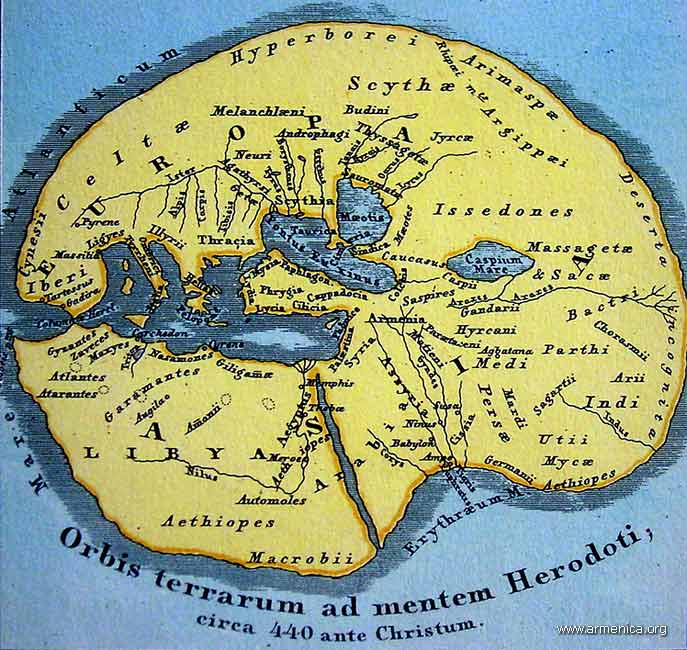
What better way to learn about the past, and what people once made of the world around them, than to study maps? A few days ago I read a fascinating passage in Herodotus: "If, therefore, I judge correctly of these things, the Ionians are mistaken with respect to Egypt; but if their opinion is correct, then I will show that neither the Greeks nor the Ionians themselves know how to reckon, when they say that the whole earth consists of three divisions, Europe, Asia, and Libya; for they ought to add a fourth, the Delta of Egypt, if it be not a part either of Asia or of Libya." A wonderful picture of the world.

I post here some wonderful recent on-line articles dealing with history, cartography, and cultural context. (One piece in particular got me thinking about an iPhone app I'd like to see. How about an interactive historical, walking map of 18th-century Boston? Strolling around the city, the iPhone-toting flaneur would notice that he would be under water were he at this or that place in 1770.)

Michael Church, "The Truth about Maps: How Cartographers Distort Reality," The Independent, March 20, 2010.

As a fascinating new exhibition shows, it's not always what they put in that matters – but what they leave out

What is a map? In effect, says Peter Barber, head of maps at the British Library, a map is a lie. "Unless you have a scale of one-to-one, every map is subjective, and always will be," he explains. "You have to select what you put on it." And selection involves rejection.

Throughout history, such lies have generally served purposes which have been political, religious or philosophical rather than scientific. >>>

Shirley Dent, "Literary London on your iPhone," Guardian Books Blog, March 23, 2010

A new iPhone application which brings the capital's literary heritage to life has made me a hazard on the streets of London. >>>

Cora Lewis,"Maps and Manuscripts Illustrate an Old Worldview," Yale Daily News, March 23, 2010

Napoleon Bonaparte famously had his men re-draw the world’s map to make France larger, but he wasn’t the only historic figure who tried to alter the public’s perceptions with cartography.

“Invented Bodies: Shapely Constructs of the Early Modern,” now on view at the Whitney Humanities Center, features maps and manuscripts from the 15th through 18th centuries, depicting Europeans’ interpretations of their world — from realistic renderings to fantastical imaginings. >>>

Steven Heller, "The World as Their Canvas," New York Times, March 5, 2010

There’s nothing like sitting by the fire with a good book, except maybe sitting by the fire with a good map—or better yet, a good book about maps. I’ve noticed an upsurge in cartographic interest these days, especially for maps’ value as conceptual artwork. >>>

Michael Elliott, "A World Map Under Eastern Eyes," Time, February 25, 2010

What does China really think of the U.S.? Spend some time in the Middle Kingdom, and you'll hear both protestations of admiration and plenty of disparaging comments about the West. Such attitudes have a long history. In 1602 the imperial Chinese court learned that the inhabitants of North America were "kindly and hospitable to strangers." >>>

Wednesday, February 24, 2010

Göbekli Tepe, the Origins of Religion, and Early Societies

Randall Stephens

An amazing archeological find is changing what we think of ancient societies and human development. Göbekli Tepe is the first human site of worship--at 11,500 years old--a startling neolithic temple. The site, not attached to a village or settlement, also challenges what archeologists and anthropologists make of the roots of religious belief. Did civilization produce religion? Did religion produce civilization?

Newsweek's Patrick Symmes reports on the find and its chief archeologist, Klaus Schmidt. (Patrick Symmes, "History in the Remaking: A Temple Complex in Turkey that Predates Even the Pyramids is Rewriting the Story of Human Evolution," Newsweek, February 19, 2010.) "The site isn't just old," writes Symmes:
it redefines old: the temple was built 11,500 years ago—a staggering 7,000 years before the Great Pyramid, and more than 6,000 years before Stonehenge first took shape. The ruins are so early that they predate villages, pottery, domesticated animals, and even agriculture—the first embers of civilization.
See also:
Andrew Curry, "Gobekli Tepe: The World’s First Temple?" Smithsonian Magazine, November 2008.
Gobekli Tepe was first examined—and dismissed—by University of Chicago and Istanbul University anthropologists in the 1960s. As part of a sweeping survey of the region, they visited the hill, saw some broken slabs of limestone and assumed the mound was nothing more than an abandoned medieval cemetery.
Sandra Scham , The World's First Temple," Archeology (November/December 2008).
Before the discovery of Göbekli Tepe, archaeologists believed that societies in the early Neolithic were organized into small bands of hunter-gatherers and that the first complex religious practices were developed by groups that had already mastered agriculture.
Nicholas Birch, "7,000 Years Older than Stonehenge: The Site that Stunned Archaeologists," The Guardian, April 23, 2008.
Never mind wheels or writing, the people who erected them did not even have pottery or domesticated wheat. They lived in villages. But they were hunters, not farmers.

Wednesday, January 27, 2010

Cahokia: Donald Yerxa's Interview with Timothy R. Pauketat and the January issue of Historically Speaking On-line

Randall Stephens

The January issue of Historically Speaking is now up on Project Muse. As a preview, I post below a part of Donald Yerxa's fascinating interview with Timothy R. Pauketat on Cahokia, site of a sophisticated pre-Columbian civilization near the Mississippi river.

The landscape and burials there long perplexed American settlers. In 1826 poet Micah P. Flint wrote these lines on the enigmatic mounds. His romantic soliloquy still resonates all these years later:

Ye mouldering relics of departed years!
Your names have perished; not a trace remains;
Save, where grass-grown mound it's summit rears,
From the green bosom of your native plains
Say! do your spirits wear oblivions chains?
Did Death forever quench your hopes and fears?

Cahokia: An Interview with Timothy R. Pauketat
Conducted by Donald A. Yerxa

Almost 1,000 years ago the city of Cahokia emerged with amazing suddenness on the edge of the Mississippi River where only a few small towns and villages had once existed. Cahokia became the hub of a major pre-Columbian Indian nation, but by 1400 the sprawling city had disappeared. Only the giant earthen mounds remained. Timothy R. Pauketat’s recent book, Cahokia: Ancient America’s Great City on the Mississippi (Viking, 2009), reconstructs this mysterious culture, drawing on the work of a number of archaeologists, including his own. Senior editor Donald A. Yerxa interviewed Pauketat, a professor of anthropology at the University of Illinois, on November 13, 2009.

Donald A. Yerxa: Would you provide our readers with a brief summary of the rise and fall of Cahokia?

Timothy R. Pauketat: Cahokia’s rise has been a particular interest of mine, and it remains a work in progress, since the more we know, the better questions we ask and the more we keep developing our explanation. The fall of Cahokia isn’t as dynamic of a research topic, but we still have a good general idea of what was happening. So here it goes.

Cahokia’s rise can be broken down into the slow growth of what I’ve called “Old Cahokia,” and the abrupt transformation of that big village into what I call “New Cahokia.” It’s New Cahokia that you see today, the city with pyramids and plazas. Old Cahokia was a very large agricultural village, possibly the seat of a loose confederation of villages or perhaps regional communities of people who minimally ranged across most of the northern American Bottom (which is the large patch of Mississippi River floodplain east of modern-day St. Louis), and maximally might have included other agricultural villages farther up and down the Mississippi. Farming was good in the American Bottom, and especially around Old Cahokia, which began to attract immigrants around 800 A.D. By 1000, in fact, Cahokia was probably the largest village in the Midwest, with perhaps 1,000-2,000 residents. That might have been it, end of story.

But—and we’re not really sure why—around 1050 the Cahokians redesigned their village into a city, with numerous large earthen pyramids surrounding one large plaza, and lesser pyramids enclosing smaller plazas to the north, east, and west. Many immigrants poured in, both local farmers from nearby villages and people from as far away as southern Missouri and northeast Arkansas. Something was attracting them, and it had to have truly tugged at their sensibilities, because Cahokia swelled pretty quickly to about 10,000 people. And that population estimate doesn’t include Cahokia’s suburbs, outlying towns, and new satellite villages, many of which were also being founded and populated in the years immediately after 1050. All of this gives one the impression of a great expansive new culture, which is why I’ve dubbed it ancient America’s Big Bang.

We have found and analyzed massive deposits of refuse from giant religious festivals dating to the decades after 1050. At one of these festivals Cahokians butchered 2,000 deer, cooked large fish and vats of pumpkin and sumpweed soups and stews, ate many berries, and smoked large amounts of strong tobacco. Unprecedented sacrificial rituals began shortly after 1050. These seem to have involved the sacrificing of young adult women every decade or so; the exact timing is still speculative. Such activity suggests that Cahokians were building a new religion that attracted followers from surrounding regions.

Yerxa: How has our understanding of Cahokia changed in recent decades?

Pauketat: Cahokia was misunderstood for a long time, even into the 1990s. Many archaeologists didn’t stop to think of the historical impacts that Cahokia and Cahokians might have had on the entire middle of the continent. Now archaeologists think about history differently, and they are beginning to appreciate that Cahokians had tremendous effects on American Indians’ identities and heritage for centuries, even impacting the ways in which Europeans colonized North America and then Anglo- Americans expanded the young U.S. westward. Those Europeans and Anglo-Americans didn’t know it, but they were being alternately enabled or impeded by descendants of Cahokians and a landscape radically changed by Cahokians centuries earlier. >>> read on

Table of Contents, Historically Speaking, January 2010

A Complex Parade: Problems and Prospects for Picturing the Nation
Wilfred M. McClay

On Using History
Mike Rose

Murder by Duel: Welch, West Virginia, 2009
Bertram Wyatt-Brown

The Hidden Dimension: “European” Treaties in Global Perspective, 1500-1800
Peter A. Coclanis

How to Teach the Writing of History: A Roundtable

Riding the Melt
Stephen J. Pyne

Historians on Writing
Michael Kammen

How to Write a Paper for This Class
Jill Lepore

Response to Stephen Pyne
John Demos

Peter’s War: An Interview with Joyce Malcolm
Conducted by Chris Beneke

The American Archipelago
Kenneth Weisbrode

The Midwestern Historical Imagination

Beyond the Frontier: An Interview with David Brown Conducted by Donald A. Yerxa

Midwestern States of Mind: Regionalism in American Historical Writing
Ian Tyrrell

Patriotic Progressives
Paul Gottfried

Cahokia: An Interview with Timothy R. Pauketat
Conducted by Donald A. Yerxa

Letters

Monday, December 28, 2009

End-of-Year History On-Line Roundup

Randall Stephens

Trapped in the Midwest because of a snowstorm, I've been catching up on some on-line reading. Choice items I've come across:

"Digitizing Monk," Here and Now, WBUR, December 24, 2009
BOSTON–Father Columba Stewart has made it his mission to digitize precious manuscripts found in some of the most threatened communities around the world, including Lebanon during the 2006 war with Israel, Iraq, and Ethiopia. The project has discovered and preserved chronicles of how the early Christians living in the Middle East perceived the arrival of the Crusaders, as well as the oldest known Ethiopian-language copy of every book in the Bible. >>>

"Digital Scripture," NGM Blog, December 8, 2009
A fourth-century Bible that includes the earliest known complete copy of the New Testament now has a 21st-century address: codexsinaiticus.org. For much of its existence, the sacred text—handwritten on parchment in ancient Greek—resided at St. Catherine’s Monastery in the Sinai, from which it takes its name. As with many old manuscripts, it was eventually split up, and some of it was lost. Only 823 of an estimated 1,487 pages survive. >>>

"Google & the Future of Books: An Exchange," New York Review of Books, January 14, 2010,
By Paul N. Courant, Laine Farley, Paula Kaufman, John Leslie King, Theodore Koditschek, Anthony Lewis et al.
To the Editors:
In his recent article criticizing the Google settlement ["Google and the New Digital Future," NYR, December 17, 2009], Robert Darnton fails to acknowledge the significant role that libraries have had in the creation of Google Book Search as well as the concrete steps they are taking to address the sorts of concerns he raises. >>>

"800 years on the Cam: Low living and high thinking at Cambridge University, from Henry III to Peter Mandelson," by Peter Linehan, Times Literary Supplement, December 16, 2009
This year the University of Cambridge celebrated its 800th birthday, an anniversary no less secure than any other of thirteenth-century origin, with an “anniversary portrait”, a handsome volume illustrated with the reminiscences of recent and not so recent alumni. >>>

"'War Is Over! If You Want It': John and Yoko, 40 Years Later," The Nation Blog, Jon Wiener, December 27, 2009
"War Is Over! If you want it" – a full page ad in the Sunday New York Times Dec. 27 must have puzzled many readers. The ad marked an anniversary: it was 40 years ago today that John Lennon and Yoko Ono launched their "War Is Over!" campaign, with billboards in New York, London, Hollywood, Toronto, Paris, Rome, Berlin, Athens and Tokyo proclaiming the message in giant black letters on a white field – and in much smaller type at the bottom, "Happy Christmas, John and Yoko." The message was repeated on posters, leaflets, and newspaper ads. >>>

Friday, October 23, 2009

Anglo-Saxon Treasure: The Border of History and Prehistory

Randall Stephens

In late September the NYT reported on a massive Anglo-Saxon find: "LONDON — For the jobless man living on welfare who made the find in an English farmer’s field two months ago, it was the stuff of dreams: a hoard of early Anglo-Saxon treasure, probably dating from the seventh century and including more than 1,500 pieces of intricately worked gold and silver whose craftsmanship and historical significance left archaeologists awestruck."

More recently in the October 14, 2009 issue of the TLS, Alex Burghart writes about "The 1,500-piece collection unearthed from the Staffordshire mud" which is "the richest collection of gold from Anglo-Saxon England ever found." This find brings up all sorts of questions about Anglo-Saxon England. The date of the find is already being debated along with the circumstances and context. Burghart observes: "There is always a temptation to link any rich Anglo-Saxon archaeology with a king. Sutton Hoo has often been called the grave of Raedwald of East Anglia (d.616–627), and the burial chamber from Prittlewell, Essex, has been linked with early kings of Essex, though the associations are far from provable. Some authorities, no doubt, will look at the bent crosses of the Staffordshire Hoard and claim it as the booty Penda of Mercia (d.655), the last great pagan King of Anglo-Saxon England. Such guesswork is good fun, but it is also slightly disingenuous."

The whole can of worms opened by the discovery is particularly interesting to historians. Questions it brings up are fascinating: What can or can't we know about the past? What are the limits and boundaries of history? When and where does the archeology come to the aid? Burghart concludes: "At present it seems unlikely that we will ever know who buried it, why they did, when they did, or where they got it." Bummer.

See also this piece in the National Geographic.

Thursday, June 25, 2009

Mary Beard on Pompeii in Historically Speaking

Randall Stephens

The latest issue of Historically Speaking includes my interview with Mary Beard. I post an excerpt of it here. The full piece can be accessed on Project Muse.

Rome Unearthed: An Interview with Mary Beard on Pompeii and the Ancient World

Mary Beard is Professor of Classics at Cambridge University. She was Visiting Sather Professor of Classical Literature for 2008–2009 at the University of California, Berkeley. Beard is the author of a variety of essays and books on the ancient world, including: Religions of Rome, with John North and Simon Price (Cambridge University Press, 1998); The Parthenon (Harvard University Press, 2002); and The Roman Triumph (Harvard University Press, 2007). Beard is also the classics editor at the Times Literary Supplement, and she is the author of the popular blog, “A Don’s Life.”

Beard’s scholarship has long challenged certain widely held views of the ancient world. Her recent book The Fires of Vesuvius: Pompeii Lost and Found (Harvard University Press, 2008) introduces a note of mystery and uncertainty into what we think we know about Pompeii and the lives of ancient Romans. Pompeii was not frozen in amber, she argues. Its history stretches back centuries before the 79 A.D. eruption of Vesuvius, and it bears the marks of later excavations. “The bigger picture and many of the more basic questions about the town remain very murky indeed,” she writes. Historically Speaking editor Randall Stephens recently interviewed Beard about her work and popular perceptions of the distant past.

Randall Stephens: Do you remember your first visit to Pompeii?

Mary Beard: I have a very vivid memory of my first visit. I went with a friend. I’d been studying Pompeii at Cambridge as an undergraduate, and she hadn’t. I was going to be the guide. I was devastated when we got there. So much of what I’d learned, particularly about the art and the wall decorations, had been made to seem so clear and so important and so sort of fixed. But none of the stuff I saw in Pompeii matched what I’d learned. There seemed to be a huge gap between people’s desire to explain it and systematize it and what you actually saw when you walked around.

Stephens: In The Fires of Vesuvius you write, “The fact is that we know both a lot more and a lot less about Pompeii than we think.” Could you say a little about what you mean here?
Beard: What is amazing about Pompeii is that you can walk around and try to reconstruct the life of the town. I remember walking down the street a few years ago and noticing little holes drilled in the curbstones, often outside houses, but not always. I’d never seen these mentioned in books. My husband and I started trying to hash this puzzle out, and we decided that they must be where they tied up animals. There had to be tethering posts because there were loads of mules and other animals going through the city. I eventually found a few articles debating what they were. So all you need to do is go to Pompeii with your eyes open and say: “I wonder what that was.”

Stephens: Even ancient graffiti, which you point out is so ubiquitous at Pompeii, gives us a more complex picture of this world than one might think.

Beard: You can go into a house and, even if you don’t read Latin, you can see that some of the graffiti scrolled on these walls is about three feet high. Well, that’s obviously someone kneeling down, or it’s a child—much more likely a child. I think there’s an enormous amount of fun in trusting your innate powers of observation and going from there.

Stephens: The layers of interpretation and the layers of ruins that you’ve uncovered in the book are intriguing. How much of what we know of Pompeii is shaped by what happened after the eruption of Mount Vesuvius?

Beard: It has an interesting history after the eruption—in the period, that is, when we think of Pompeii as happily asleep, waiting for rediscovery. While I’m suspicious of the view that the Romans undertook an enormous and systematic rescue operation soon after the eruption, it seems extremely likely that salvagers came to get the really valuable stuff—statues from the forum, and so on. It must have been frightfully dangerous, and some of them almost certainly died in the attempt because the tunnels would have collapsed. Some of the bodies that you can now see—casts of bodies made where their remains left a vacuum in the lava—are almost certainly bodies of looters, not those of the unfortunate Pompeii victims. . . .

Wednesday, June 3, 2009

Adam’s Ancestors

An Excerpt of Donald Yerxa's Interview with David Livingstone from Historically Speaking (June 2009)

David N. Livingstone is a professor of geography and intellectual history at Queen’s University Belfast. He is a fellow of the British Academy and the Royal Society of Arts. One of the most talented and perceptive scholars currently working on the history of science and religion, Livingstone is esp
ecially interested in exploring the spatial as well as the temporal contexts within which ideas are produced and consumed. Among his many books are Putting Science in Its Place: Geographies of Scientific Knowledge (University of Chicago Press, 2003) and most recently Adam’s Ancestors: Race, Religion, and the Politics of Human Origins (Johns Hopkins University Press, 2008). Historically Speaking senior editor Donald A. Yerxa caught up with Livingstone on March 3, 2009, to discuss his latest book as well as his approach to intellectual history.

Donald A. Yerxa: Your most recent book, Adam’s Ancestors, is a history of pre-Adamite thinking. What is pre-Adamism?

David N. Livingstone: Pre-Adamism is actually a notoriously simple idea, though its consequences are multifaceted. It’s the idea that the Adam of the Hebrew Bible and the Old Testament is not the first human being. In some incarnations Adam is simply the father of the Jewish people, whereas in other versions Adam is viewed as the father of Caucasian people. But the material point of pre-Adamism, at least in its early days, is that there were, and perhaps indeed continue to exist, peoples who are descended from a pre-Adamic or at least non-Adamic source. This would mean that there were at least two (and arguably more than two) creations of the human species. In pre-Adamism lie the origins of what anthropologists used to call polygenesis. And, indeed, that has been and continues to be something of an issue right up to contemporary paleoanthropology. Should we look at all humans as derived from a single source, let’s say, a “mitochondrial Eve”? Or did the human species emerge in many different places? So the debate in that sense, without the biblical significance of Adam, continues to be important in thinking about human origins more generally.

Yerxa: How significant was pre-Adamism in Western intellectual history prior to Darwin?

Livingstone: There are a couple of things to be said about this. Another historian who worked on this subject some years ago, Richard Popkin, made the arresting suggestion that pre-Adamic theory was much more destabilizing to European intellectuals in the 17th century than the Copernican revolution or indeed the mechanical universe of the Newtonians. Popkin reasoned that pre-Adamism challenged human beings’ sense of their own identity, of who they really were. For a very long time, going back to the church fathers, to Augustine, and indeed to much earlier times, descent from Adam came to be a definition of what it was to be human. So I’m inclined to agree with Popkin because while you can scarcely find an advocate for the idea after 1655 when it first began to achieve wider publicity, you find many, many refutations. Although pre-Adamism seems initially to have had few converts, a lot of people felt the need to refute it.

Yerxa: Throughout your book it is clear that this notion is quite versatile and can be adapted to a number of arguments. Could you speak to that?

Livingstone: Pre-Adamism can be used for many contradictory purposes and is hugely adaptable in different environments. Let me just pick out three or four of these. Initially, when it was first put forward in the 1650s by Isaac La Peyrère, it was rapidly castigated as a heresy. Emissaries from the Vatican picked up La Peyrère when he was traveling in what is now Belgium and took him off to Rome, where he was forced to recant before the pope. Clever devil that La Peyrère was, however, the recantation never really admitted he was wrong. Pre-Adamism was considered heretical because it plainly challenged a literal reading of the Genesis narrative. One has to rethink a sequence of other related theological precepts if one accepts the notion that there were pre-Adamites. For example, did they also fall from grace? How representative is Adam of the human race? How does original sin come into the world? How is it transmitted?

Pre-Adamism has been quite versatile, however. In the 19th century—and indeed on into the 20th century—the idea was promulgated by those who were much more conservative in their theological outlook. It was adopted in a new guise by conservative believers who wanted to hold onto the historic significance of Adam while at the same time take some notion of human evolution seriously. So pre-Adamism, once deemed a massive heresy, was later taken up by conservative, orthodox believers.

Let me provide another instance of its adaptability. In the 1650s La Peyrère thought that Adam was the father of the Jewish race, but he was convinced that we all, whether Jews or not, participate to some degree in the benefits of the Jewish religious tradition and divine action in the world through the children of Israel. So in that sense, pre-Adamism is inclusive, humanitarian, and sweeps all of humanity—whether Jewish, Adamic or non-Jewish, non-Adamic—into a human family that benefits in Israel’s redemption. But later, pre-Adamism was used for the grossest forms of racism by depicting certain racial groups as non-Adamic and thus inferior and perhaps even subhuman. So pre-Adamism has been used for both humanitarian and racist purposes. . . .

Yerxa: You were trained as a geographer, and yet much of your recent writing has been in the area of intellectual history and the history of science. Is this an unusual intellectual trajectory? Or is this question premised on a false assumption about what it is that geographers do?

Livingstone: Being trained in geography in my generation encompassed aspects of physical science as well as the humanities and social sciences. Geography integrates nature and culture, or environment and society. Since its institutionalization in the 19th century, geography has always had considerable interest in the history of exploration. If you go back to early examination papers at the University of Oxford, you will find papers dealing with the history of what was then called, in those colonially unconscious days, the Age of Discovery or the Age of Exploration. So there was always interest in the history of growing geographical knowledge about the globe. . . .

Wednesday, May 20, 2009

Summer Travels in Roman Western Europe

Randall Stephens

In time for the summer travel season Elaine Sciolino writes an interesting piece on "Roman France" in the NYT travel section.

Over the years, I have discovered traces of Roman civilization throughout the country, from Arras in the north to Dijon in the center and Fréjus in the south. My hunt for Roman Gaul has turned up treasures in the oddest places, including the middle of wheat fields, the foundations of churches and the basements of dusty provincial museums. . . .

If French history books tend to underplay ancient Roman rule, local politicians and entrepreneurs in the south do not. In the summer, area restaurants offer “Roman” menus with 2,000-year-old recipes: dishes prepared with cumin, coriander, mint and honey.

The article features a map with key sites marked out and a slide show. Related pieces include: "Traces from When Paris Was Roman" (May 17, 2009); and "Amid the Glory of France, the Grandeur that Was Rome" (May 17, 2009).

There's plenty to see across the channel, too. About a year ago Kevin Rushby wrote about a short trip he and his four-year-old daughter made to Hadrian's Wall and the Housteads fort, "England's Great Wall" Guardian, March 29, 2008. The serpentine wall is UN World Heritage site and a fascinating window into the distant past.

Built around AD124 in a commanding position on a swathe of the dramatic Whin Sill escarpment, Housesteads is one of the most important sites of Roman remains in Britain, in its day the last decent bath house before the great unwashed of Caledonia. . . .

Many interesting finds have come from the fort, even more from the settlement of hangers-on clustered below its walls. Two counterfeiting coin moulds from the 3rd century AD were discovered next to the remains of a house, the forger's den. Under his floor were two skeletons, one with a knife still stuck in the ribs.

Thursday, April 23, 2009

What Can Historians Learn from Biologists

David Meskill

Can historians learn anything from biologists? Jared Diamond’s 1997 book Guns, Germs, and Steel sparked a flurry of interest among at least some historians, who published a special forum in the American Historical Review and held panels at the annual AHA meetings. A more common response to Diamond, however, if I go by numerous conversations with historians, has been disapproval tinged with an almost visceral rejection. I surmise that this disdain derives from the book’s underlying biological premise: as with other species, Diamond argues, humans’ fates have been determined by the environment and the availability of natural resources. It may also have to do with Diamond’s emphasis on the long term and his relative lack of interest in individuals and events. None of these things - the biological roots of human behavior, environmental determinism, the disregard for particularities – historians can abide. In fact, most historians have probably not taken a stance one way or the other in regard to Diamond’s book – or to the growing number of intellectual encroachments by natural scientists onto terrain usually reserved for historians. Whether due to parochialism or indifference, we historians remain, as Daniel Lord Smail has put it, in the “grip of sacred history.” We still conceive of history as starting with civilization and written records some 5,500 years ago in Sumer.

The relatively generous attention paid to Diamond actually confirms the extent of the problem: Guns, Germs, and Steel was a gripping, popular (but not unserious) read. If it hadn’t been a best-seller, it almost certainly would not have earned the AHA’s attention. Less visible, but in many cases even more important, works by natural scientists usually go unnoticed by historians. Since the 1980s, for example, several schools of biologists and anthropologists have been developing ambitious theories of “coevolution.” These approaches treat human culture as an evolutionary system in its own right and investigate its properties and its interactions with its genetic counterpart. They thereby hope to develop comprehensive, indeed potentially revolutionary theories of human behavior, something one might think would be of interest to historians. Yet a JSTOR search reveals that none of these books received even one review in a historical journal.

They deserve better. The following is a review of one of such project: Robert Boyd and Peter Richerson’s 1985 book Culture and the Evolutionary Process. (The others are Luigi Cavalli-Sforza and Marcus Feldman’s Cultural Transmission and Evolution: A Quantitative Approach [1981] and William Durham’s Coevolution [1991].)

Culture, as Boyd and Richerson (B & R) define it, includes all episodes of social learning of ideas and behaviors, whether by teaching or imitation. B& R provide considerable evidence that social learning of this type – and not individual learning or rationality, as neo-classical economics and rational choice approaches assume – plays a predominant role in human behavior. They point to the numerous cases of “cultural inertia,” in which people don’t respond to new circumstances, even for generations (see, for example, David Hackett Fischer’s excellent book, Albion’s Seed, on the persistence of different English folkways in America), and to psychologists’ plentiful evidence that people operate by various, often inaccurate, rules of thumb.

According to B & R, culture shares with genetic inheritance the three crucial ingredients necessary for an evolutionary system: variation, inheritance, and selection. I.e. people have different ideas and act in a variety of ways; they pass along these cultural traits to “cultural offspring,” who usually include their biological offspring, but can also include friends, students, etc.; finally, some cultural traits get passed on more often than others (for reasons to be discussed below). B & R therefore call their model a “dual inheritance” theory.

Crucially, the two inheritance systems, while similar, are not identical. Cultural evolution allows for “acquired variation.” It is Lamarckian. In genetic evolution the behavior of an individual has no effect on the genes she/he passes on. With culture, however, an individual can learn something on her/his own or otherwise pick and choose from her/his cultural heritage. What she/he passes on to cultural offspring has been changed. Additionally, in cultural evolution there can be many “parents,” not just the two of biological reproduction.

B & R distinguish between several different “forces” giving cultural evolution its directions. The first two, which belong together, they call “guided variation” and “direct bias.” Guided variation involves the interaction of individual learning, or innovation, and cultural evolution by social learning. Despite having culturally inherited certain ideas or behaviors, individuals are also capable of assessing their surroundings and options and developing a new response, one they did not inherit. For example, a medieval farmer stumbles upon a different way to plow his fields. If he can ascertain that this is an improvement over traditional methods – something that may not be easy to evaluate - he is then likely to pass on this new variant to his cultural offspring, in this case primarily his sons but perhaps also neighbors. Direct bias, on the other hand, is less innovative: the person does not invent a new response, but adopts one of the various options she has inherited from various cultural parents. However, a certain predisposition may favor – directly bias – one kind of cultural alternative over the others. In the cases of both guided variation and direct bias, criteria are needed to make individual judgments. And these criteria, B & R argue, must come from our genes, i.e. from biological natural selection. For this reason, they refer to these two forces as socio-biological. That is, cultural inheritance will track and reinforce biological inheritance.

With the other forces – which, B & R argue, are likely to be more important than guided variation or direct bias - this is not necessarily the case. The socio-biological forces depend on individual learning or discrimination: even in the case of direct bias, the individual has to make judgments about the available options, which bias to apply, and how to do so. But gathering such information has costs, which opens the door to other, less costly “forces” affecting social learning. Two of these are “indirect bias” and “frequency bias.” With the first, one individual identifies another whom he deems successful – an older brother, a village headman, a movie star - and copies many behaviors from him. Overall, this process is less costly because the first individual is not trying to assess which behaviors of the cultural parent have caused the latter’s success; he simply copies many or all of them. However, in some instances, B & R argue, costly “runaway” processes can ensue: people go to great lengths to dress like rock stars they admire, efforts that could never be justified in terms of clothes’ evolutionary selective power. The process is akin to the evolution of the peacock’s tail, in which an arms race over sexual attraction may impair the creatures’ survival. Frequency bias means that people simply copy the most frequent cultural variant, which will often prove to be a simple, efficient strategy.

A final force is natural selection, not of genes, in this case, but of cultural variants. This arises because genetic and cultural evolution are asymmetrical. We inherit our genes from our mother and father and the same two individuals are often important for imbuing us with our ideas and behaviors. However, we often inherit cultural variants from many other sources as well (siblings, teachers, friends, religious leaders, public figures). These non-parental sources will become relatively more important as we age. If we only inherited culture from our parents, B & R argue, we might expect that those ideas and behaviors would track or conform to the biological impulses we inherited from them: for example, we would imbibe the idea that having large families is a good thing. However, the existence of asymmetrical strands of cultural inheritance means that ideas and values can spread that may run counter to our biological imperative (and hence to what our biological parents on their own would teach us). Thus, teachers and other professionals may spread the message that professional success - something they themselves have achieved, and which requires sacrifices of the time and energy necessary for physical reproduction – is of great value. A Darwinian competition would then ensue – between biological parents and teachers over whose ideas and values would spread faster. B & R make a convincing case that this kind of asymmetric inheritance and the resulting natural selection of cultural variants probably lie at the root of the current, extraordinary demographic revolution. People, especially in affluent countries, are having fewer and fewer babies. Biology and biological Darwinism would predict just the opposite: as resources increase – as they have for humans over the last century or more, especially in industrialized countries – birth rates should steadily increase. In these cases, B & R say, the cultural variant “enjoy your own life, be successful professionally, don’t acquire these noisy, troublesome little creatures” has undermined the biological imperative to reproduce as much as possible.

Because of these final three forces – indirect bias, frequency bias, and natural selection of culture – cultural evolution will often come into tension with the dictates of biological evolution. They help to explain the internal conflicts that individuals experience much the way Freud described the struggles between id and superego. They also distinguish B & R’s approach from a strictly socio-biological one and from William Durham’s 1991 Coevolution, which foresees greater – though still not complete - congruence between biology and culture.

Finally, B & R ask how cultural evolution itself could have arisen in the first place? This is especially acute given cultural evolution’s frequent (biologically) maladaptive consequences. The generic answer is that as long as culture is overall biologically adaptive, its benefits outweigh its considerable costs. More specifically, culture may be expected to arise under particular environmental circumstances. If the environment remains constant for long periods, the best strategy is to hard-wire behavior in genes. This eliminates the costs associated with learning, either of the individual or social kind. If, on the other hand, the environment changes significantly quite frequently, then not only is genetic hardwiring the wrong strategy. Social learning, with its inertia, is as well. Under these circumstances, individual learning is the best option. Social learning – which allows for limited individual learning and variation – is best when the environment remains fairly constant but changes to some degree. In later work, B & R suggest that this was precisely the environment during the ice ages starting 2.5 million years ago and lasting until 12,000 years ago.

Culture and the Evolutionary Process is a challenging work. B & R rely frequently on mathematical models, which will not always be easy to follow unless one already has considerable facility with such methods. However, the authors always take the trouble to walk the reader through the main steps and, most important of all, the conclusions of the models. They also offer tangible examples from history and other social sciences to illustrate their points. The book should be required reading for anybody interested in “big” or “deep” history. Even at smaller time scales, the book offers a very stimulating framework for analysis, especially for thinking about broad patterns of social and cultural development. So, can historians learn anything from biologists? Yes – if they are willing.

David Meskill received his Ph.D. in Modern European History from Harvard University in 2003. He will be Assistant Professor of History at Dowling College in fall 2009. He blogs regularly at http://davidmeskill.blogspot.com/

Monday, April 20, 2009

Roman Holiday

Barry Strauss

According to ancient tradition, the city of Rome had a birthday. It was founded on April 21 in what, according to the most common version, was the year 753 B.C. We don’t have to trust the story in order to use the date as a reason to ponder ancient Rome’s legacy.

If we ask, as Monty Python did, “what have the Romans ever done for us?” we might be surprised at the answer. Truth to tell, we might be surprised at the question. Rome is better known these days as the center of the Catholic Church and the capital of Italy than as one of the twin fountainheads of the West (the other, of course, is Greece). Yet we needn’t probe too deeply in order to find that conviction.

Americans, for example, haven’t gotten over their pride at (or fear of) being the new Rome. Despite numerous obituaries, Latin is alive and well as a subject of study in schools and universities. Nor can the story of Christian origins be told outside the Roman context. Meanwhile, both Islamic and Jewish histories assign a major role to Rome or its successor state, the Byzantine Empire (also known as Rome and, rightly so, since the “Byzantines” called themselves Romans). Rome still matters.

With that in mind, here is an exercise in civic literacy: two sets of questions about the legacy of ancient Rome. The first set consists of traditional problems while the second features new scholarly approaches. They cover a wide range of subjects, but, I fear, not wide enough to hide my own limitations. To begin with:

1. What was the constitution of the Roman Republic? Was it a democracy, oligarchy or so-called mixed regime? Why did the American Founders lean so heavily on the Roman Republic as a model? Did they understand the reality of the Republic or were they misinformed?
2. How (and why) did Rome, a small city-state in Central Italy, conquer an empire that covered the shores of the Mediterranean and stretched from Britain to Iraq? Why were the legions so successful? Did Rome’s empire bring the blessings of peace (the famous pax Romana) or did the Roman historian Tacitus get it right when he had one of Rome’s enemies say of Rome “They make a desert and call it peace” (Agricola 98).
3. Why did Rome’s republican government collapse and why was it replaced by a monarchy?
4. To what extent was Rome an original culture? To what extent did it merely absorb, codify and preserve the culture of Greece?
5. To what extent was Rome a slave society? How can we admire a slave society today?
6. At its height, the city of Rome was the largest and most powerful city in the world, with a population of over a million people. What was life there like?
7. Why and how did Rome change from paganism to Christianity?
8. Why did the Roman Empire in the West decline and fall? Why did it survive in the East as the Byzantine Empire? Is “decline and fall” the right way to think of the fate of the Roman Empire in the West or is “transformation and change” a better model?

Here is the second set of questions:

9. What new evidence and new methodologies are uncovering the ancient environment and ecology? Was environmental pollution a problem in the Roman era?
10. How is the evidence of material culture revealing the lives of Roman women, including working women? How is it adding to the history of the Roman family? Roman childhood?
11. How are archaeology and anthropology opening a window into the medical dimension of Roman life? How advanced were Roman science, technology, and engineering?
12. How can we explain the brutal phenomenon of gladiatorial games? What new evidence do we have of a gladiator’s life?
13. What new evidence and models are there for the ancient economy? How did it support the Empire’s large population? For that matter, what advances in demography allow us to chart that population?
14. How is new research filling in the picture of the lives of the Italian peoples whom Rome conquered: e.g., Bruttians, Celts, Etruscans, Greeks, Lucanians, Samnites? Likewise, how is new research illustrating the lives of the peoples outside of Italy whom Rome conquered or whom Rome fought and failed to conquer: e.g., Carthaginians, Celts, Germans, Greeks, Jews, Persians, Thracians? What special contribution to Roman history does the extraordinarily well-preserved evidence of Roman Egypt make?
15. What new insights emerge from a comparison of the Roman Empire with Han Dynasty China? What new evidence has been found of Roman trade in goods and ideas with such countries as India, China, Arabia, and Kush?
16. How is new research describing the experience of Roman battle?
These questions offer a glimpse of the subject, not an overview. But birthday parties only start the new year.

Barry Strauss teaches ancient history at Cornell University. His most recent book is The Spartacus War (Simon & Schuster, 2009). He blogs at http://www.barrystrauss.com/blog/.
Related Posts with Thumbnails